

SIEM (Security Information and Event Management)
By: Martin Johnson, Head of Product Marketing, BreachRx · Last updated: Sept 28, 2026
What is SIEM?
Security information and event management (SIEM) is a security technology that collects, normalizes, and correlates log and event data from across an organization’s systems to detect threats, support investigations, and meet compliance requirements. It gives security operations teams one place to search activity across endpoints, networks, cloud services, identities, and applications.
NIST describes a SIEM tool as an application that gathers security data from information system components and presents it as actionable information through a single interface.
SIEM combines two older disciplines. Security information management (SIM) stores and analyzes log data over time, and security event management (SEM) monitors and correlates events in real time. Gartner analysts coined the term in 2005 to describe products that brought both together.
SIEM is a detection and investigation technology. It helps a security team determine what may be happening and assemble the technical evidence needed to investigate it. When an incident becomes a legal, privacy, operational, communications, or executive event, the organization needs an enterprise response process beyond the SIEM.
How does SIEM work?
A SIEM works in five stages: collect, normalize, correlate, alert, and investigate. Each stage converts raw telemetry into progressively more useful security context so analysts can decide whether activity should be escalated into incident response.
- Collect
The SIEM ingests logs and events from firewalls, endpoints, servers, identity providers, cloud platforms, SaaS applications, email security, and other security tools. - Normalize and enrich
It converts data from many formats into a common schema and adds context such as asset owner, user identity, geolocation, and threat intelligence. - Correlate and analyze
Detection rules, behavioral analytics, and increasingly machine learning connect related events across sources. A failed login, a new privileged account, and an unusual data transfer may each look minor alone but indicate an attack together. - Alert and prioritize
When activity matches a detection, the SIEM creates an alert with a severity score so analysts can triage the most important issues first. - Investigate and retain
Analysts search historical data to scope the activity, build a timeline, and preserve evidence. Retained logs also support audits and compliance reporting.
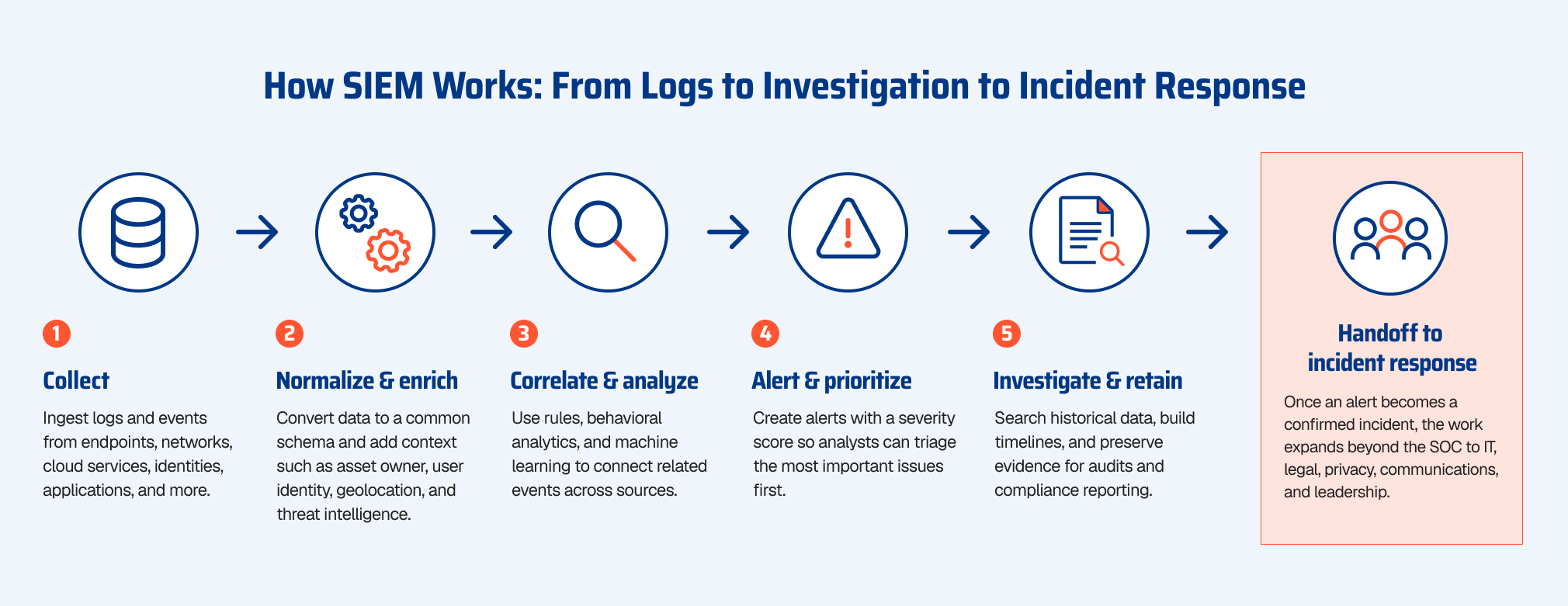
Figure 1. How SIEM works: collect, normalize, correlate, alert, investigate, then escalate to incident response.
The final handoff is where the operating problem changes. Once an alert becomes a confirmed business incident, the work expands beyond the SOC to IT, legal, privacy, communications, and leadership. Technical investigation continues, but ownership, deadlines, approvals, external communications, and decision rationale now have to move in parallel.
Where does SIEM stop and enterprise incident response begin?
SIEM stops being the primary system of work when an alert becomes a cross-functional business incident. At that point, technical evidence still matters, but the organization also has to manage ownership, legal and privacy analysis, regulatory clocks, communications, executive decisions, approvals, and a defensible record.
A useful way to see the handoff is as four layers: Detect → Contain → Govern → Close. SIEM leads detection and investigation; SOAR and XDR help automate technical actions and containment; CIRM coordinates the governance and enterprise-closure work that follows. The technologies can overlap, but the operating problem changes as the incident expands beyond the SOC into enterprise incident response.
That distinction matters because response workload can expand sharply after the technical incident is understood. BreachRx’s 2026 Regulatory Concurrency research modeled more than 100 reporting obligations within one organization and more than 200 across a small set of affected entities. The finding illustrates how a technical event can become a system-scale coordination problem while facts, deadlines, and stakeholders are still changing.
What are the core capabilities and use cases of SIEM?
Modern SIEM platforms center on six capabilities: log management, real-time correlation, threat detection, investigation, compliance reporting, and increasingly analytics and automation.
| Capability | What it does | Example use case |
|---|---|---|
| Log management | Centralizes and retains security logs from across the environment | Searching 12 months of authentication logs during an investigation |
| Event correlation | Links related events from different sources | Tying a phishing email to a later suspicious login and file download |
| Threat detection | Applies rules, threat intelligence, and analytics to find attacks | Detecting brute-force attempts or known malicious IP addresses |
| User and entity behavior analytics (UEBA) | Baselines normal activity and flags anomalies | Spotting an employee downloading unusual volumes of data |
| Investigation and forensics | Provides search, timelines, and evidence for analysts | Reconstructing how an attacker moved laterally |
| Compliance reporting | Produces audit-ready logs and reports | Demonstrating log review for PCI DSS or HIPAA audits |
Common SIEM use cases include detecting compromised credentials, insider threats, ransomware precursors, cloud misconfigurations, privileged account abuse, and data exfiltration.
What is the difference between SIEM, SOAR, XDR, and CIRM?
SIEM detects and investigates threats across logs. SOAR automates technical security workflows. XDR detects and responds across integrated security controls. CIRM governs the enterprise-wide response once a threat becomes a business incident.
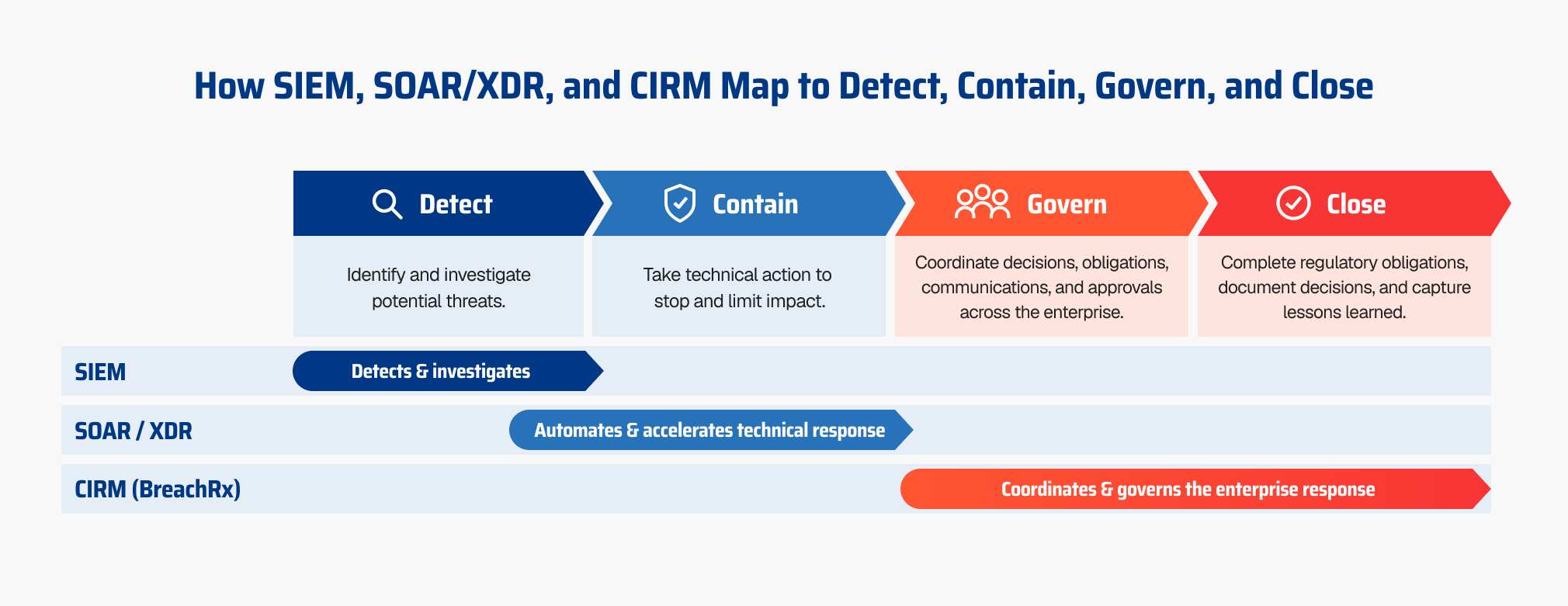
Figure 2. How SIEM, SOAR/XDR, and CIRM map to Detect, Contain, Govern, and Close across incident response.
| SIEM | SOAR | XDR | CIRM | |
|---|---|---|---|---|
| Primary purpose | Collect, correlate, and detect across logs | Automate and coordinate technical security workflows | Detect and respond across integrated endpoint, network, cloud, and identity controls | Govern cross-functional incident response |
| Typical users | SOC analysts, threat hunters | SOC, security engineering | SOC, IR teams | Security, IT, legal, privacy, communications, executives |
| Core output | Alerts, searches, reports | Automated playbook actions | Correlated detections and containment actions | Decisions, obligations, approvals, and a defensible incident record |
| Data scope | Logs and events from any source | Data from connected security and IT tools | Telemetry from the vendor’s integrated controls | Technical facts plus legal, regulatory, business, and executive context |
| Where it stops | Alerting and investigation | Technical workflow or case closure | Technical containment | Enterprise incident closure |
These technologies work together rather than replacing one another. Many vendors now bundle SIEM, SOAR, and XDR features, so product labels overlap. A useful test is whether a tool helps the SOC find and contain threats, or helps the whole organization make and document incident decisions.
For a deeper comparison, read SOAR vs. CIRM: 5 Gaps Your SOAR Platform Does Not Close.
What role does SIEM play in incident response?
SIEM is usually where an incident starts: it detects suspicious activity, supplies the evidence to confirm it, and supports scoping and forensics throughout the response. It is the SOC’s primary tool for the Detect and Analyze phases of cyber incident response.
During an incident, SIEM data helps responders:
- Confirm whether an alert is a true incident
- Identify affected users, systems, and data
- Build a timeline of attacker activity
- Map observed behavior to MITRE ATT&CK® tactics and techniques
- Verify that containment worked and monitor for recurrence
- Preserve log evidence for legal, regulatory, insurance, and law enforcement needs
In the NIST Cybersecurity Framework 2.0, SIEM supports the Detect function, especially continuous monitoring and adverse event analysis. NIST SP 800-61 Revision 3 places those detection activities within a broader incident response model that also includes governance, communications, response, and recovery.
SIEM helps establish technical truth; enterprise response turns that evidence into governed decisions. A SIEM can show that 40,000 customer records were accessed. It cannot decide whether the event triggers a 72-hour GDPR notification obligation, who approves a customer notice, or when the board is briefed. Those decisions require legal interpretation, business context, accountable ownership, and a contemporaneous record of why the organization acted as it did.
Which regulations require SIEM or log monitoring?
Few regulations name SIEM directly, but many require logging, log review, audit controls, or retention that organizations commonly implement with a SIEM. The control requirement is the important point: a SIEM is one common way to operationalize it, not usually the regulatory requirement itself.
| Regulation or standard | Logging requirement |
|---|---|
| PCI DSS v4.0.1 Requirement 10 | Review specified audit logs at least daily (10.4.1), use automated mechanisms for audit log review (10.4.1.1), and retain audit log history for at least 12 months, with at least the most recent 3 months immediately available for analysis (10.5.1). |
| HIPAA Security Rule 45 CFR 164.312(b) | Implement hardware, software, and/or procedural mechanisms that record and examine activity in information systems that contain or use ePHI. |
| NYDFS 23 NYCRR 500.6 | Maintain audit trails designed to detect and respond to cybersecurity events that could materially harm operations; retain those cybersecurity-event audit-trail records for at least three years. |
Logs also matter after detection. Regulators, auditors, insurers, and courts may ask what the organization knew and when. Retained SIEM data can help establish the technical timeline, but defensibility also depends on connecting that evidence to the decisions, approvals, notifications, and rationale that followed.
Requirements depend on the organization, jurisdiction, industry, and applicable law. The examples above are illustrative and are not legal advice.
What are the limitations of SIEM?
SIEM is essential for visibility, but it is not a complete detection program or a complete incident response capability. The most common limitations fall into five areas.
- Alert volume and noise. Poorly tuned rules generate large numbers of low-value alerts, and analysts can miss the ones that matter.
- Cost and data growth. Ingestion- or volume-based pricing makes it expensive to collect every log source, so teams often make trade-offs about what to monitor.
- Tuning and expertise. Detection content needs continuous engineering as environments, threats, and log formats change.
- Coverage gaps. A SIEM can only correlate the data it receives. Missing cloud, SaaS, or identity logs create blind spots.
- The governance handoff. A SIEM tracks technical alerts and cases. It is not designed to assign legal, privacy, communications, or executive owners; manage regulatory clocks; route business approvals; or preserve the rationale behind cross-functional decisions.
This is a different scaling problem: SIEM scales data and detection; enterprise response must scale decisions and coordination. Detection can take minutes, while the business response may continue for days, weeks, or months. Without a dedicated enterprise response layer, that work often fragments across email, chat, meetings, documents, and spreadsheets.
How is SIEM changing?
SIEM is shifting toward cloud-native, data-lake, and AI-assisted security operations architectures. Vendors are adding AI for triage, investigation, query writing, summarization, and detection engineering, while SIEM, SOAR, and XDR capabilities increasingly converge into unified security operations platforms.
As detection throughput rises, cross-functional decision throughput becomes the next constraint. Faster triage can move more incidents to enterprise response sooner, but legal analysis, regulatory assessment, communications, approvals, and executive decisions still require governed execution. That is why AI incident response has to extend beyond alert summarization and technical investigation.
How does BreachRx work with SIEM?
BreachRx complements rather than replaces SIEM. The Rex Platform™ sits above the detection and remediation stack and coordinates enterprise response when a SIEM alert becomes a business incident.
Connect detection to response. Rex integrates with security operations tools including Google SecOps, CrowdStrike, and Cortex XSOAR. Incidents can launch from SOAR platforms, Slack, intranet forms, and other connected sources, while a documented GraphQL API and Zapier support additional integration patterns.
Bring every function into one response. Security, IT, legal, privacy, communications, and executives work from a shared incident record with assigned owners, tasks, decisions, approvals, and status. This is the enterprise layer that traditional security operations tools are not designed to manage.
Map facts to obligations. Cyber RegScout® connects evolving incident facts to potentially applicable requirements across 200+ cybersecurity and privacy regulations, helping teams prioritize deadlines, owners, and reporting actions as facts change.
Keep a defensible record. Rex captures actions, approvals, decisions, timestamps, and rationale alongside technical evidence so the organization can show not only what happened, but how and why it responded.
Use AI inside the response workflow. Rex AI® and Maestro use live incident context to help update tasks, deadlines, workflows, and reporting while people retain judgment, approval, and accountability for material decisions.
A SIEM helps close the alert. Cybersecurity Incident Response Management (CIRM) helps close the enterprise incident. Request a demo to see how Rex connects detection evidence to coordinated enterprise response.
Frequently Asked Questions
1. What does SIEM stand for?
SIEM stands for security information and event management. It combines security information management (SIM), which stores and analyzes logs, with security event management (SEM), which monitors events in real time.
2. What is an example of a SIEM?
Widely used SIEM platforms include Splunk Enterprise Security, Microsoft Sentinel, Google Security Operations, IBM QRadar, CrowdStrike Falcon Next-Gen SIEM, and Elastic Security. Open-source options include Wazuh.
3. What is the difference between SIEM and log management?
Log management collects, stores, and searches log data. SIEM adds security-specific normalization, correlation, threat detection, alerting, and compliance reporting on top of that data.
4. What is the difference between SIEM and SOAR?
SIEM detects and investigates threats by correlating log data. SOAR automates and coordinates technical response actions that follow, such as enriching alerts, isolating endpoints, or opening tickets.
5. What is the difference between SIEM and XDR?
SIEM ingests logs from almost any source for broad visibility and compliance. XDR focuses on detection and response across a vendor’s integrated security controls, such as endpoint, network, identity, and cloud.
6. Who uses a SIEM?
Security operations center (SOC) analysts, threat hunters, incident responders, detection engineers, and compliance teams are the primary SIEM users. Managed security service providers also run SIEMs on behalf of customers.
7. Is SIEM required for compliance?
Most regulations do not name SIEM, but standards and rules such as PCI DSS, HIPAA, and NYDFS Part 500 require logging, log review, audit controls, or audit trails that organizations commonly implement with a SIEM. PCI DSS v4.0.1 also requires automated mechanisms for specified audit log reviews.
8. Can a SIEM respond to incidents?
Many SIEMs include automated response features, often through built-in SOAR. These handle technical actions. Enterprise incident response also requires legal, privacy, communications, and executive decisions, which a SIEM is not designed to manage.
9. Is SIEM still relevant with XDR and AI?
Yes. SIEM remains the central place to collect and retain logs from across the environment for detection, investigation, and compliance. Many platforms now add AI and converge with XDR and SOAR rather than being replaced by them.
10. What happens after a SIEM detects an incident?
Analysts triage and confirm the alert, then escalate it to incident response. For significant incidents, the response expands to IT, legal, privacy, communications, and leadership, who assess impact, regulatory obligations, notifications, customer communications, and executive decisions. A CIRM platform coordinates that enterprise response and preserves a shared record of the work.
By: Martin Johnson, Head of Product Marketing, BreachRx · Last updated: Sept 28, 2026