
How to Evaluate Out-of-Band Communication Products
When companies begin evaluating out-of-band communication products, they usually start with a sensible question: how will we communicate if corporate email and collaboration systems become unavailable or compromised? A secure alternative channel addresses an immediate vulnerability, but it also exposes a larger buying decision. Once the response team has moved into that channel, where will it find its procedures, assign work, assess notification obligations, approve decisions, and maintain an accurate record of the incident?
If those activities still depend on systems inside the affected environment, the organization has moved its conversations without moving its capacity to respond. People may be able to exchange messages while struggling to access the information and processes needed to act on them.
For buyers, this is the distinction that deserves more attention: an out-of-band communication product should be evaluated against the response it must support, including the work that continues after everyone has successfully logged in.
Start with the response you need to sustain
Gartner® Buyer’s Guide to Out-of-Band Communication Platforms for Cybersecurity Incidents provides a useful starting point by distinguishing three approaches: ad hoc tools, dedicated OOB platforms. Cybersecurity Incident Response Management platforms.
The report states that, “If the only reason you want an OOB communication platform is for the handling of a cyberincident, then a CIRM platform is likely the best option for you.” It also identifies BreachRx among representative CIRM providers, thoughGartner does not endorse any vendor, product, or service depicted in its research.
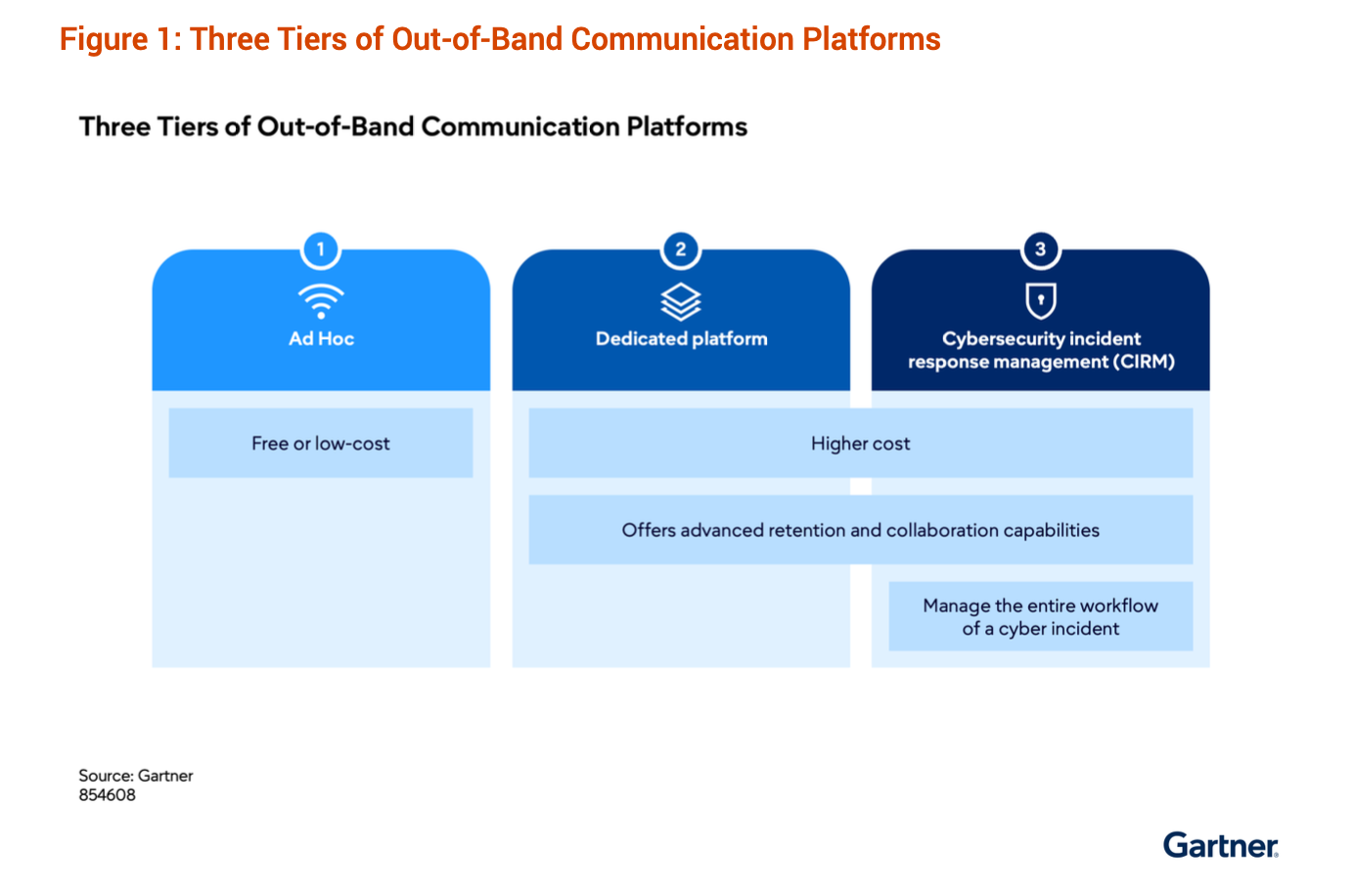
This distinction matters because products can solve different problems while appearing on the same shortlist. An organization seeking a separate environment for sensitive executive conversations may prioritize different capabilities from one preparing to coordinate an enterprise cyber response. Before comparing vendors, define what must keep functioning during disruption. That definition should guide your requirements, demonstrations, and cost comparisons.
Four questions can help turn a communications evaluation into a test of operational readiness.
Will the environment survive the failure you are planning for?
Out-of-band communication uses channels separate from the organization’s primary communications environment. However, a separate application does not necessarily provide independence from the systems that could fail. An emergency messaging tool might still require corporate sign-in, send account recovery links to corporate email, or depend on administrative access that becomes unavailable during containment. The useful buying question is therefore specific: which compromised or disabled systems can this product operate without?
Ask vendors to demonstrate how employees, executives, and outside partners enter the environment when the relevant corporate dependencies are unavailable. Include account recovery, participant verification, administrative access, and approved alternative devices in the demonstration. A product that works during an email outage may face different constraints during an identity compromise. Evaluate it against your scenarios and make those assumptions explicit, so the team knows when and how the alternative environment can be used.
Can teams execute their procedures after they connect?
A secure channel gives responders a place to communicate, but communication alone does not establish ownership or drive execution. Consider a customer notification: someone must verify the facts, determine applicable obligations, prepare the message, obtain approval, and send it. Each step has an owner and dependencies. If the platform only captures the conversation, responders may still need spreadsheets, document repositories, and ticketing systems to manage the work. Those dependencies become important when normal systems are disrupted.
Ask vendors to show how your actual procedures would operate in their environment. Can teams access instructions, assign actions, monitor completion, and manage handoffs across security, legal, privacy, IT, and communications? Can executives see current status and unresolved decisions without asking someone to assemble another update? A demonstration built around one of your response scenarios will reveal whether the product supports coordinated execution or requires your team to build that coordination around it.
Can access controls and records support the broader response?
As an incident develops, participation can expand to outside counsel, forensic investigators, insurers, business leaders, and communications advisers. These participants need different information and authority. Evaluate whether the product can give each person access appropriate to their assignment, while separating sensitive discussions from general coordination. For legal workstreams, access controls and separation should support counsel’s practices. No technology creates privilege on its own; the platform’s role is to support the process under appropriate legal oversight.
The same evaluation should examine the incident record. Message history captures conversation, but understanding the response requires knowing which facts informed a decision, who approved it, and what happened next. Ask vendors to demonstrate those connections, along with retention and export capabilities. Consider how much reconstruction your team would need after an incident. Reconciling chats, spreadsheets, documents, and tickets consumes effort that should be included in the buying decision, alongside licensing and implementation costs.
Will people know how to use it when it matters?
An emergency platform introduces a practical challenge: some of its most important users may rarely touch it. Executives, outside advisers, and business leaders need to participate without learning an unfamiliar operating model during an incident. Evaluate onboarding, mobile access, external participation, and opportunities to rehearse. Run an exercise that removes corporate communications and requires participants to work in the alternative environment. Observe whether they can locate instructions, complete handoffs, and authorize actions. That performance provides a stronger basis for selection than a feature checklist alone.
How BreachRx Approaches Out-of-Band Communications
BreachRx combines Out-of-Band Comms with integrated Cybersecurity Incident Response Management in the Rex Platform™. Teams get a protected communications environment connected to runbooks, assigned actions, obligations, decisions, evidence, and a governed incident record. Legal teams can use separated, access-controlled workstreams, while executives access the incident context needed to make decisions. Communications remain connected to the work they support, giving teams a place to coordinate and execute the enterprise response.
For buyers, the advantage is continuity. Moving out of corporate systems does not have to mean abandoning the processes that govern the response. Evaluate OOB products by asking what your organization can still accomplish once it makes that move. Secure communications are the entry requirement. The stronger investment preserves the ability to act, maintain accountability, and keep the response moving.
Don’t just move the conversation out of band. Move the entire response.
Choosing an out-of-band communication platform?
Download Gartner® Buyer’s Guide to Out-of-Band Communication Platforms for Cybersecurity Incidents to explore the available approaches, capability differences, and trade-offs that can inform your evaluation.
Download The Gartner® Buyer’s Guide
Compare OOB approaches for maintaining trusted communications and response during system disruptions.
Source:
Gartner, Buyer’s Guide to Out-of-Band Communication Platforms for Cybersecurity Incidents, By Phillip Shattan, Wayne Hankins, 4 August 2026
GARTNER is a trademark of Gartner, Inc. and/or its affiliates..
Gartner does not endorse any company, vendor, product or service depicted in its publications, and does not advise technology users to select only those vendors with the highest ratings or other designation. Gartner publications consist of the opinions of Gartner’s business and technology insights organization and should not be construed as statements of fact. Gartner disclaims all warranties, expressed or implied, with respect to this publication, including any warranties of merchantability or fitness for a particular purpose.
This graphic was published by Gartner, Inc. as part of a larger research document and should be evaluated in the context of the entire document. The Gartner document is available upon request from BreachRx