

Out-of-Band Communication for Incident Response
By: Martin Johnson, Head of Product Marketing, BreachRx · Last updated: Sept 26, 2026
What is out-of-band communication?
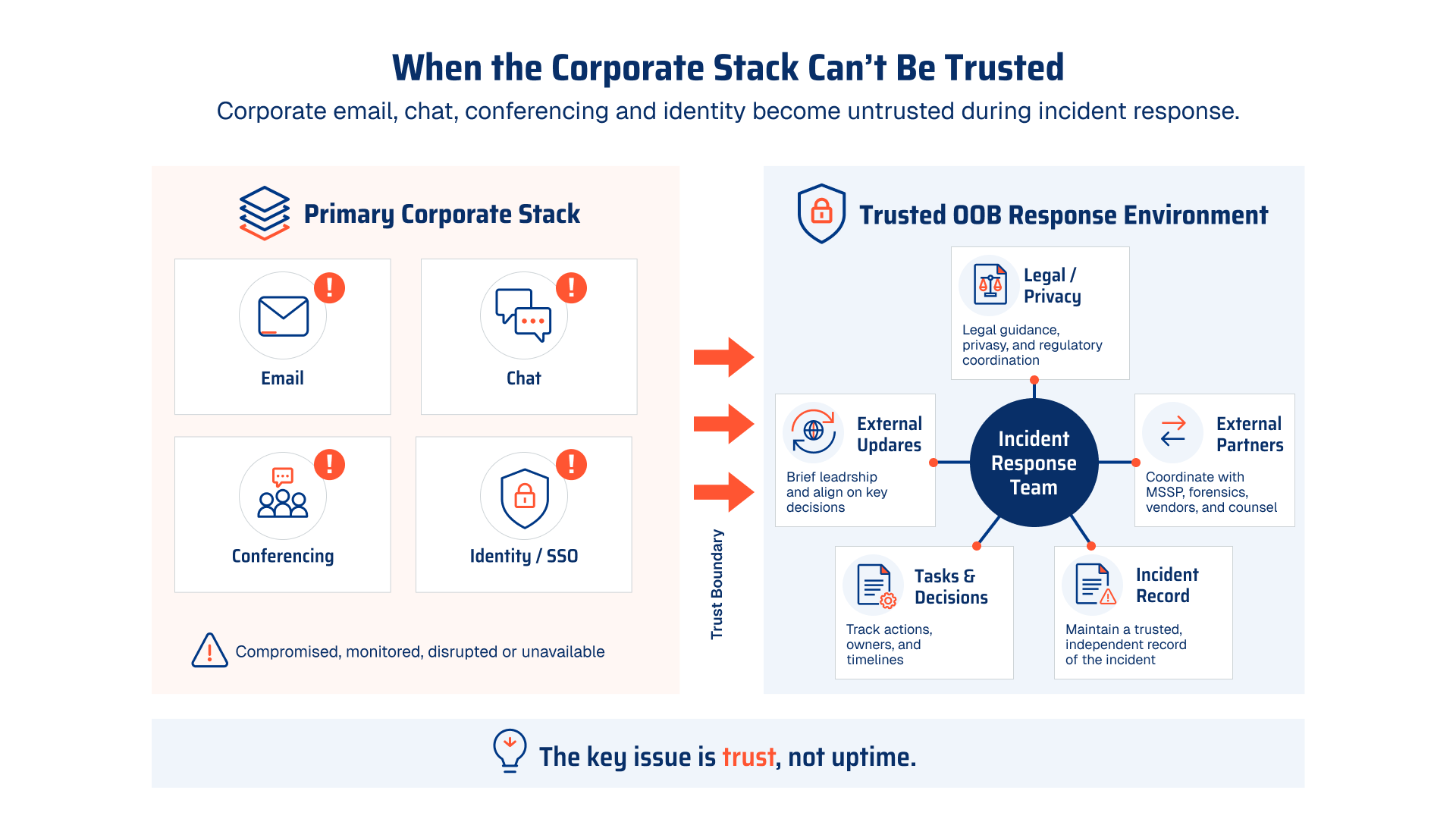
Out-of-band (OOB) communication uses independent channels to coordinate cyber incident response when corporate email, messaging, identity, conferencing, or collaboration systems may be compromised, monitored, disrupted, or unavailable. They give responders a trusted place to exchange information and keep decisions moving without relying on the environment being investigated.
MITRE ATT&CK® mitigation M1060 recommends establishing secure out-of-band channels that do not depend on potentially compromised primary network infrastructure, so adversaries cannot intercept, disrupt, or tamper with incident communications. NIST SP 800-53 control SC-37 similarly calls for channels that are physically or logically separate from primary operational networks. The CISA #StopRansomware Guide recommends out-of-band communication during ransomware response when attackers may be watching.
The key idea is trust, not uptime. A system can still be online while no longer being safe for incident coordination. If an attacker can read, impersonate, disrupt, or manipulate a channel, availability alone does not make it trustworthy.
What is the difference between in-band and out-of-band communication?
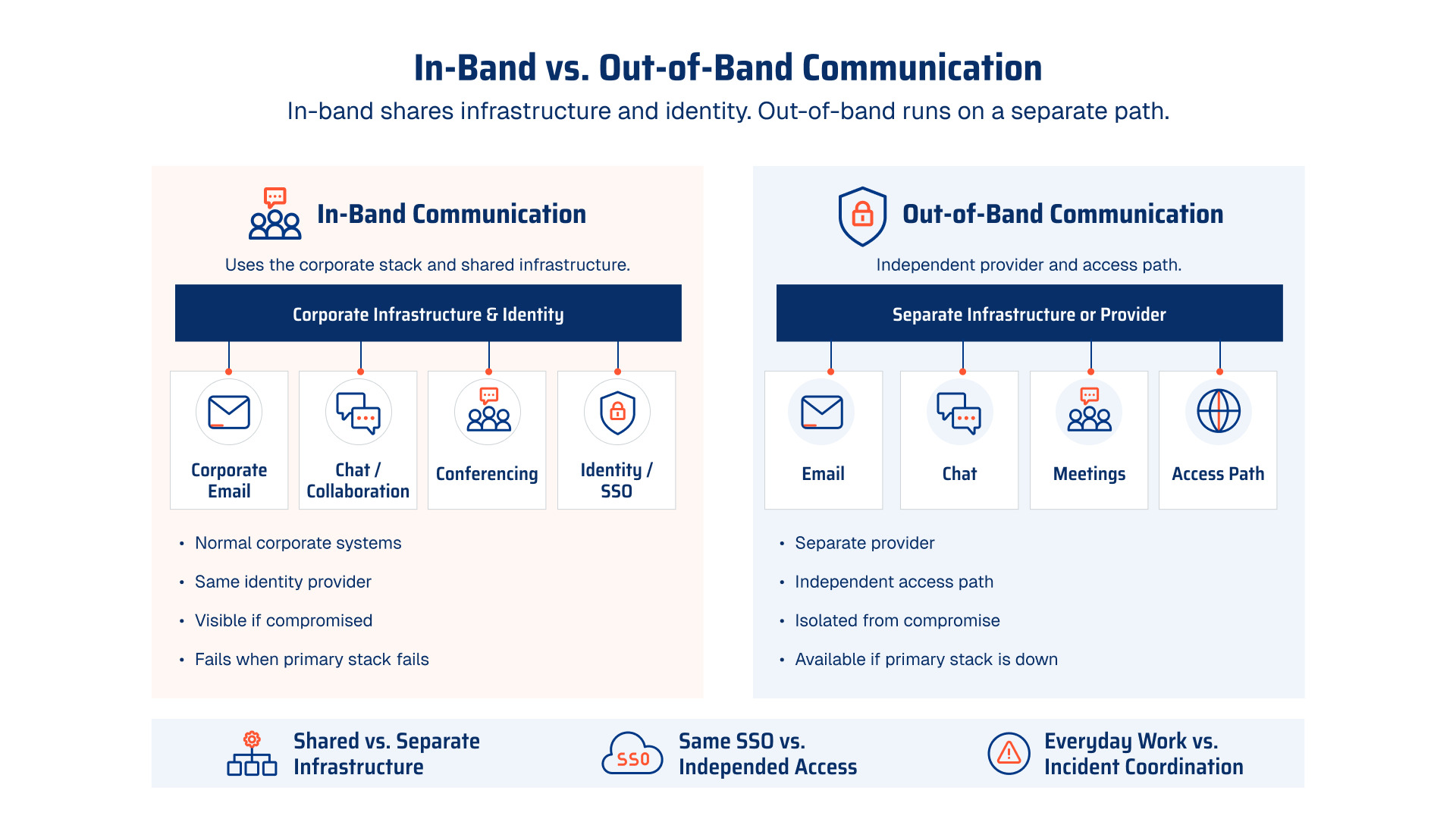
In-band communication uses the organization’s normal systems, such as corporate email, Slack or Microsoft Teams, and SSO. Out-of-band communication uses a separate path that does not share the same infrastructure, identity, or administrative control.
| In-band communication | Out-of-band communication | |
| Infrastructure | Corporate network, email, and collaboration stack | Separate infrastructure or provider |
| Identity | Same SSO and identity provider used for daily work | Independent or break-glass access path |
| Exposure during an incident | Visible to an attacker who controls those systems | Isolated from the compromised environment |
| Availability during an outage | Fails when the primary stack fails | Designed to stay usable when the primary stack is down |
| Typical use | Everyday work | Incident coordination when normal channels can’t be trusted |
The term comes from telecommunications, where out-of-band signaling carried control information on a channel separate from the data. In networking, “out-of-band management” means a separate path for administering devices. This page covers the incident response meaning.
Why is out-of-band communication important during a cyber incident?
A serious cyber incident can create a second crisis inside the first: the response team loses confidence in the tools it normally uses to coordinate. That can slow containment, expose response strategy, fragment executive updates, and push teams into improvised channels exactly when discipline matters most.
Two well-known events show both failure modes.
Compromise: Uber, 2022. An attacker gained access to Uber employee accounts, including Slack, and posted a message to employees announcing the breach. Uber took several internal communications and engineering systems offline. The collaboration tool responders would normally use was itself inside the incident.
Outage: the 2024 CrowdStrike update. A faulty sensor update affected an estimated 8.5 million Windows devices and disrupted airlines, healthcare, and government agencies. It was not an attack, but many organizations lost the endpoints and tools they used to coordinate recovery.
BreachRx views this as more than a communications continuity problem. It is a continuity-of-command problem. Security, IT, legal, privacy, communications, executives, outside counsel, insurers, forensic firms, and critical vendors still need to make decisions from a shared set of facts while the normal corporate stack is uncertain.
When should an organization move incident communications out of band?
Move out of band whenever confidence in the confidentiality, integrity, authenticity, or availability of normal communications is materially reduced. Define the triggers, and who can make the call, before an incident.
| Trigger | Why normal communications may be unsafe |
| Identity or privileged-account compromise | Attackers may impersonate users, monitor collaboration tools, or manipulate access. |
| Business email compromise | Corporate inboxes may be controlled, forwarded, or monitored by an attacker. |
| Ransomware or destructive malware | Email, chat, file sharing, conferencing, or identity services may be degraded or deliberately taken offline. |
| Suspected attacker monitoring | Coordinating in-band may reveal containment plans, investigative steps, or timing. |
| Cloud or SaaS compromise | The collaboration provider or its admin console may be part of the incident. |
| Insider threat | Sensitive discussions may need to be separated from normal internal channels and access. |
| Major outage or recovery event | Primary tools can fail even when the cause is not malicious. |
The decision does not need to wait for proof that a system is compromised. The more useful question is whether the team can still trust the channel enough to use it for sensitive response decisions.
What are examples of out-of-band communication channels?
Common out-of-band channels include dedicated incident response platforms, separately hosted secure messaging, phone and SMS call trees, conference bridges on a separate provider, and satellite phones. MITRE’s M1060 guidance lists secure messaging apps, encrypted phone lines, satellite communications, and dedicated emergency communication systems.
| Channel | Strengths | Limitations |
| Dedicated OOB incident response platform | Built for incidents; can connect communications to tasks, decisions, and the incident record | Must be provisioned, tested, and accessible before it is needed |
| Separately hosted secure messaging | Familiar chat experience on infrastructure separate from the corporate tenant | Usually communications only; the record lives apart from the response |
| Phone and SMS call trees | Simple, widely available, useful for first alerting | Hard to scale, no shared record, easy to impersonate |
| Separate conference bridge | Supports live coordination outside the collaboration stack | No persistent documentation; dial-in details must be protected |
| Personal email or consumer apps | Immediately available | Weak access control and retention; creates governance, privilege, and recordkeeping risk |
| Satellite phones or radios | Work when terrestrial networks are down | Costly and limited; best for physical or regional disasters |
Most organizations combine channels. A phone tree might alert the incident team, who then move into a dedicated environment for the rest of the response. What matters is that each channel is independent of the systems in scope and that participants know when and how to use it.
Why is backup chat not enough?
Backup messaging solves only one layer of the problem. Enterprise incidents require coordinated execution across people, decisions, workflows, evidence, regulatory obligations, leadership updates, and external partners. A new chat room moves the conversation but can leave the response fragmented.
| Backup chat / ad hoc OOB | Enterprise OOB response environment | |
| Purpose | Alternate conversation channel | Trusted operating environment for the response |
| Stakeholders | Often security and IT first | Security, IT, legal, privacy, communications, executives, counsel, vendors |
| Work management | Separate tasks and spreadsheets | Communications connected to tasks, owners, approvals, and deadlines |
| Sensitive legal work | Depends on ad hoc channel controls | Role-based, privilege-supporting workstreams |
| Executive visibility | Manual status summaries | Curated, decision-ready leadership views |
| Incident record | Conversation sits outside the system of record | Facts, decisions, communications, and rationale stay connected |
| Readiness | Usually tested as a failover tool | Exercised as part of the full incident operating model |
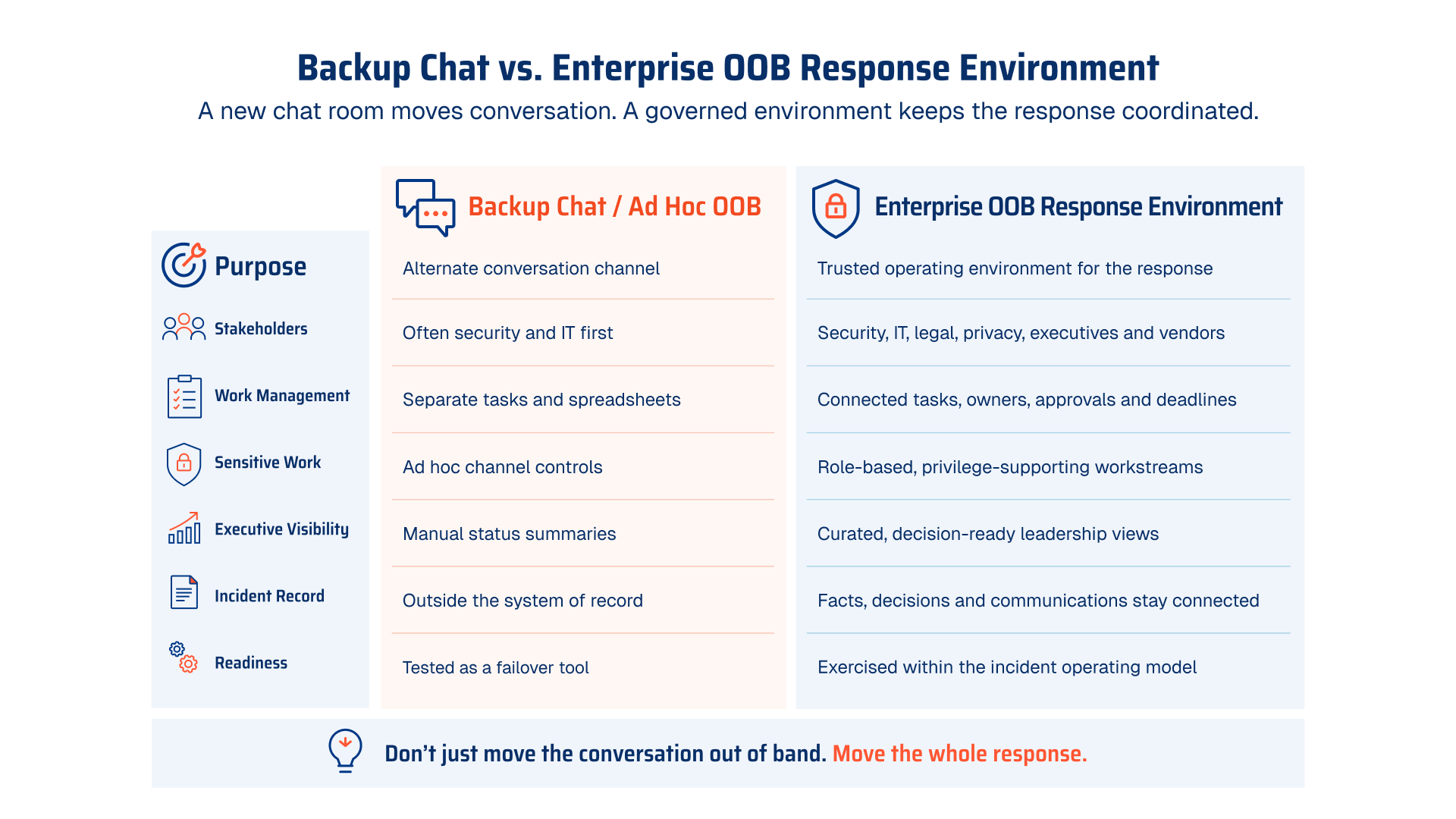
The BreachRx principle: don’t just move the conversation out of band. Move the entire response.
A resilient OOB model needs six things: an independent operating path, trusted access that doesn’t rely on the identity systems under investigation, cross-functional coordination beyond the SOC, governance for sensitive and privileged work, shared incident context that keeps everyone on the same version of the facts, and readiness proven in exercises. Redundancy asks, “Can we still talk?” Resilience asks, “Can we still govern, decide, document, and recover?”
What frameworks recommend out-of-band communication?
Several widely used frameworks and government guides recommend out-of-band communication for incident response.
| Framework or guide | What it recommends |
| MITRE ATT&CK M1060: Out-of-Band Communication Channel | Establish secure OOB channels for incident coordination, and plan to use them instead of in-network chat and email when those may be compromised. |
| NIST SP 800-53 Rev. 5, SC-37 Out-of-Band Channels | Use channels physically or logically separate from the primary network to deliver sensitive information. |
| NIST SP 800-184, Guide for Cybersecurity Event Recovery | Plan communications for recovery, including coordination with internal and external stakeholders. |
| CISA #StopRansomware Guide | Use out-of-band methods during ransomware response to avoid tipping off attackers who may be monitoring. |
These sources agree on the principle. Where they differ is scope: most focus on keeping a channel available and private, while enterprise response also needs decisions, obligations, and evidence to stay connected to that channel.
What should an out-of-band communication plan include?
A strong OOB plan defines the switch before the incident: triggers, authority, participants, access, sensitive-work boundaries, update cadence, and how to return to normal systems.
The plan should give an appropriate path into the OOB environment to every function that may make or execute a material decision: security, IT, legal and outside counsel, privacy and compliance, communications, executives, and external partners such as forensic firms, insurers, and critical vendors. Access should follow the role. Executives need decision-ready context, legal may need restricted workspaces, and technical responders need operational detail.
Test the plan the way you would use it. Include the OOB switch in tabletop exercises, with conditions such as email that is online but suspected to be monitored, an identity provider inside the incident scope, or outside counsel who must be brought in quickly.
A useful test: if the corporate inbox, chat platform, identity provider, and executive update process were suddenly untrusted, could the incident team keep operating without rebuilding its coordination model from scratch?
For a step-by-step approach, read Out-of-Band Communication: 9 Steps to Optimize Your Plan.
What are common out-of-band communication mistakes?
Sharing the same identity provider. If the OOB channel logs in through the SSO that is under investigation, it isn’t really out of band.
Waiting for proof of compromise. Teams keep coordinating in-band while debating whether the channel is safe.
Improvising on personal apps. Consumer messaging restores conversation but creates access, retention, privilege, and recordkeeping problems.
Security-only access. Legal, communications, and executives are left out and fall back to side channels.
Losing the record. Decisions made in the OOB channel never make it into the incident record, leaving gaps for regulators, insurers, and counsel.
Never practicing the switch. Credentials, contacts, and procedures are discovered to be out of date during the real incident.
How does BreachRx help with out-of-band communication?
BreachRx Out-of-Band Comms provides a secure communications environment inside the Rex Platform™, connected to the same workflows, ownership, executive visibility, regulatory context, evidence, and incident record used to manage the response.
| Capability | Role in the response |
| Out-of-band email for incident communications when the corporate inbox can’t be trusted | |
| Chat | Incident, leadership, and action chats connected to the active incident |
| Meetings | Secure video and audio conferencing outside the normal collaboration stack |
| Scratch Pad | Shared workspace for findings, hypotheses, handoffs, and working notes |
| Mobile Command™ | Secure, mobile-first executive view of status and decision-ready context |
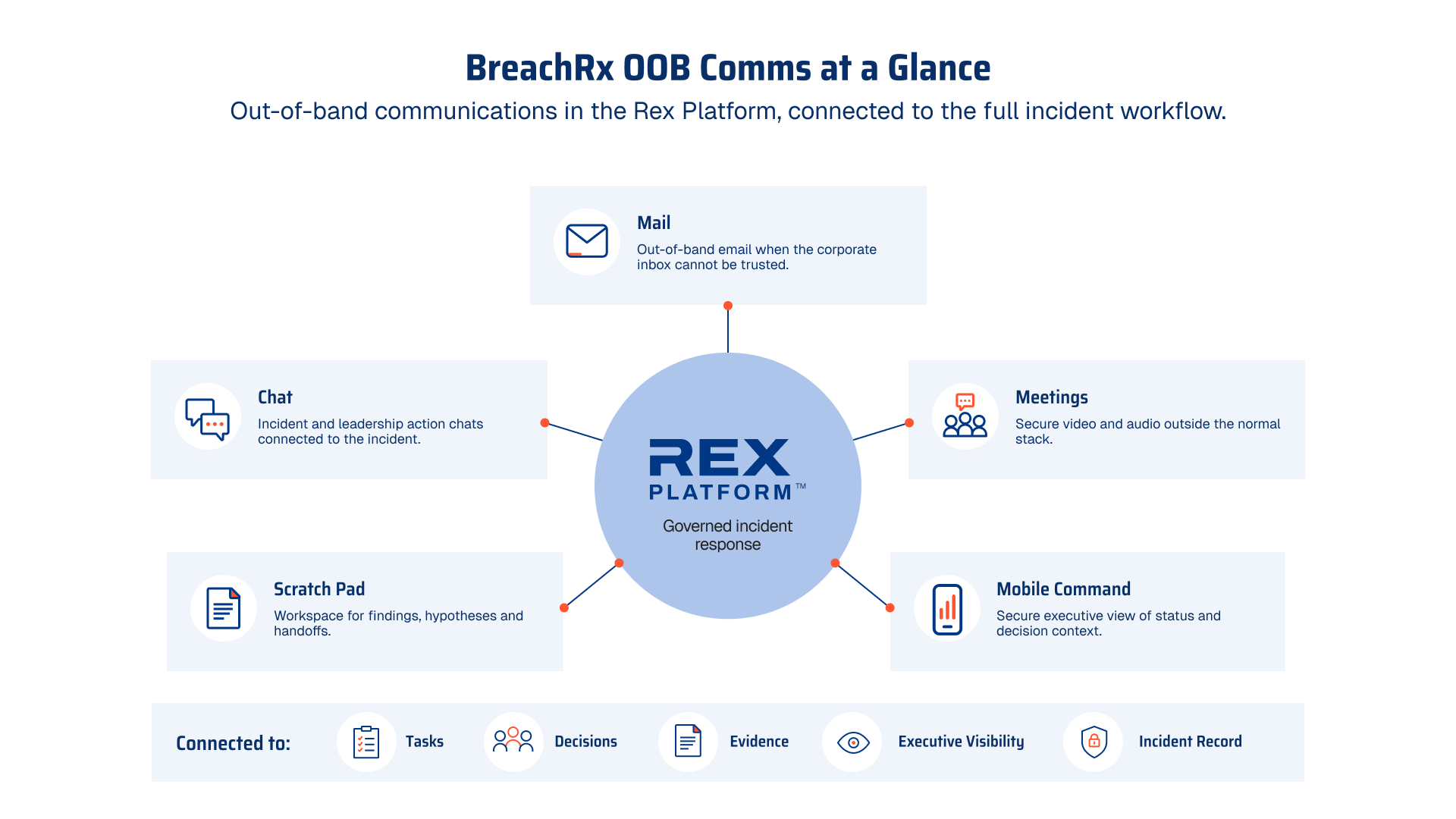
Keep the whole response operating. Security, IT, legal, privacy, communications, leadership, and authorized external partners coordinate from one governed environment.
Protect sensitive work. Role-based access can separate privileged legal or leadership discussions while keeping material decisions tied to the incident record.
Keep communications tied to action. Messages stay connected to tasks, owners, deadlines, approvals, evidence, and decision rationale.
Bring regulatory context in. Cyber RegScout® surfaces potential obligations as facts change. BreachRx’s Regulatory Concurrency Report found that modern incidents can trigger dozens or hundreds of simultaneous reporting obligations.
Practice before you need it. AI Tabletop Exercises let teams rehearse the OOB switch in the same Rex environment they will use in a real incident.
An alternate channel is useful. A trusted, governed, cross-functional operating environment is resilient. That is why BreachRx builds out-of-band communication into Cybersecurity Incident Response Management (CIRM). Request a demo.
Frequently Asked Questions
1. What is out-of-band communication in cybersecurity?
Out-of-band communication uses a channel independent of the systems affected by an incident. It lets responders keep coordinating when corporate email, chat, identity, or conferencing tools are unavailable or can’t be trusted.
2. What is an example of out-of-band communication?
Examples include a dedicated incident response platform hosted outside the corporate environment, separately hosted secure messaging, a phone or SMS call tree, a conference bridge on a separate provider, and satellite phones for physical disasters.
3. What is the difference between in-band and out-of-band communication?
In-band communication uses the organization’s normal email, chat, and identity systems. Out-of-band communication uses a separate path that doesn’t share that infrastructure, so it stays usable and private if the normal systems are compromised or down.
4. Why can’t teams just use personal email or consumer messaging apps?
Ad hoc tools restore conversation but create security, access, privilege, retention, and recordkeeping problems. Decisions made there are also easily lost from the official incident record.
5. What is the difference between out-of-band and backup communications?
Backup communications keep a channel available. Out-of-band communication keeps coordination trusted when the primary environment is uncertain, which also requires independent access, governance, and a connected record.
6. Does out of band mean completely separate from every corporate service?
Not necessarily. The design question is whether the alternate environment stays trustworthy under the failures the organization is planning for. Teams should map dependencies on identity, devices, and networks and exercise scenarios where those are affected.
7. Who should have access to out-of-band incident communication?
Anyone who may make or execute a material incident decision: typically security, IT, legal, privacy, compliance, communications, executives, outside counsel, forensic firms, insurers, and critical vendors.
8. How often should out-of-band communication be tested?
Test access and procedures regularly and include the switch in tabletop or functional exercises. Short micro-tabletops can rehearse specific handoffs, such as losing corporate chat or bringing in outside counsel.
9. How does out-of-band communication support legal privilege?
A purpose-built environment can support privilege-preserving workflows through restricted, role-based workspaces and controlled access for counsel. Organizations should follow their legal counsel’s advice for each matter.