Regulatory Concurrency Is Breaking Cyber Incident Reporting
Cyber incident reporting used to be treated as a compliance workflow: Something happened, the organization investigated, counsel assessed the applicable rules, notices were prepared, and disclosures were filed.
That model is breaking.
Our latest research on regulatory concurrency shows that modern incident reporting is no longer a linear legal process. It is an enterprise coordination problem defined by overlapping regulatory clocks, unstable facts, distributed responsibility, and multiple disclosure narratives moving at the same time.
The research examined five major incidents—Change Healthcare, Snowflake, Salesforce, 700Credit, and Salt Typhoon—and found a common pattern: organizations are no longer managing “a breach.” They are managing dozens to hundreds of concurrent obligations that start at different times, depend on different triggers, and require defensible decisions before the facts are fully stable.
That is the real shift. The problem is not simply that there are more regulations. It is that reporting obligations now behave like a distributed system under pressure. When the system state changes, every regulator, customer, executive, partner, and public-facing artifact may need to be updated consistently. Manual coordination was not built for that.
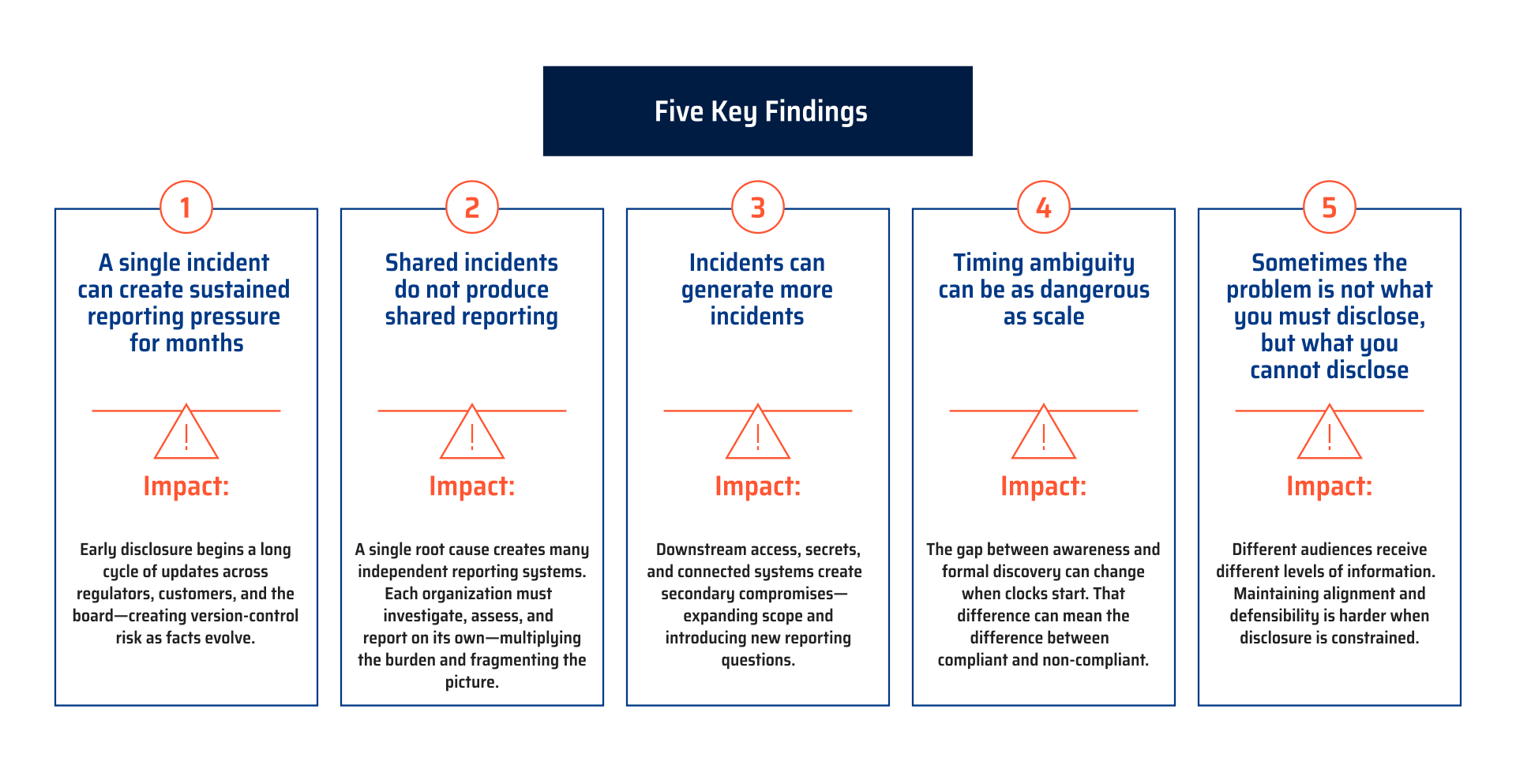
Here are the five key findings from the research and what each means for leadership teams.
1. A Single Incident Can Create Sustained Reporting Pressure for Months
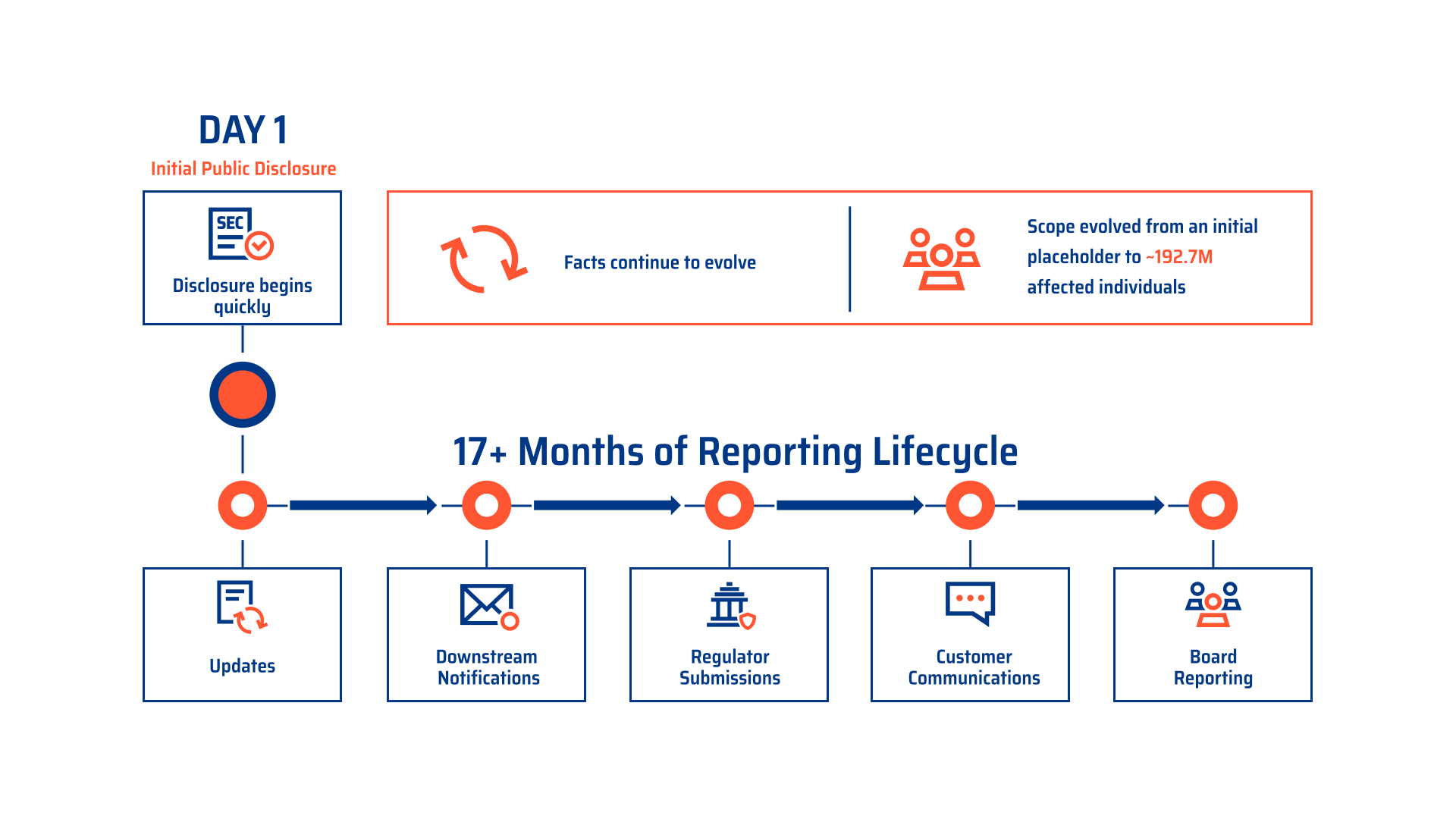
The Change Healthcare incident shows that regulatory concurrency can expand over time inside a single organization. The first public disclosure occurred quickly, but the reporting lifecycle continued for more than 17 months as the scope evolved from an initial placeholder to approximately 192.7 million affected individuals.
The operational lesson is that early disclosure does not end the reporting burden. In many cases, it begins it.
For executives, this changes how incident response should be measured. Speed still matters, but speed alone is not enough. A company can satisfy an early disclosure requirement and still face a prolonged cycle of updates, downstream notifications, regulator submissions, customer communications, and board reporting.
The impact is version-control risk. As facts evolve, every disclosure, notice, executive summary, and regulator update must remain consistent with what was known at that moment. If those artifacts are managed across email, spreadsheets, shared drives, and memory, the organization is exposed to drift. Months later, the question will not only be whether the organization filed on time. It will be whether it can explain what it knew, when it knew it, and why each decision was reasonable.
2. Shared Incidents Do Not Produce Shared Reporting
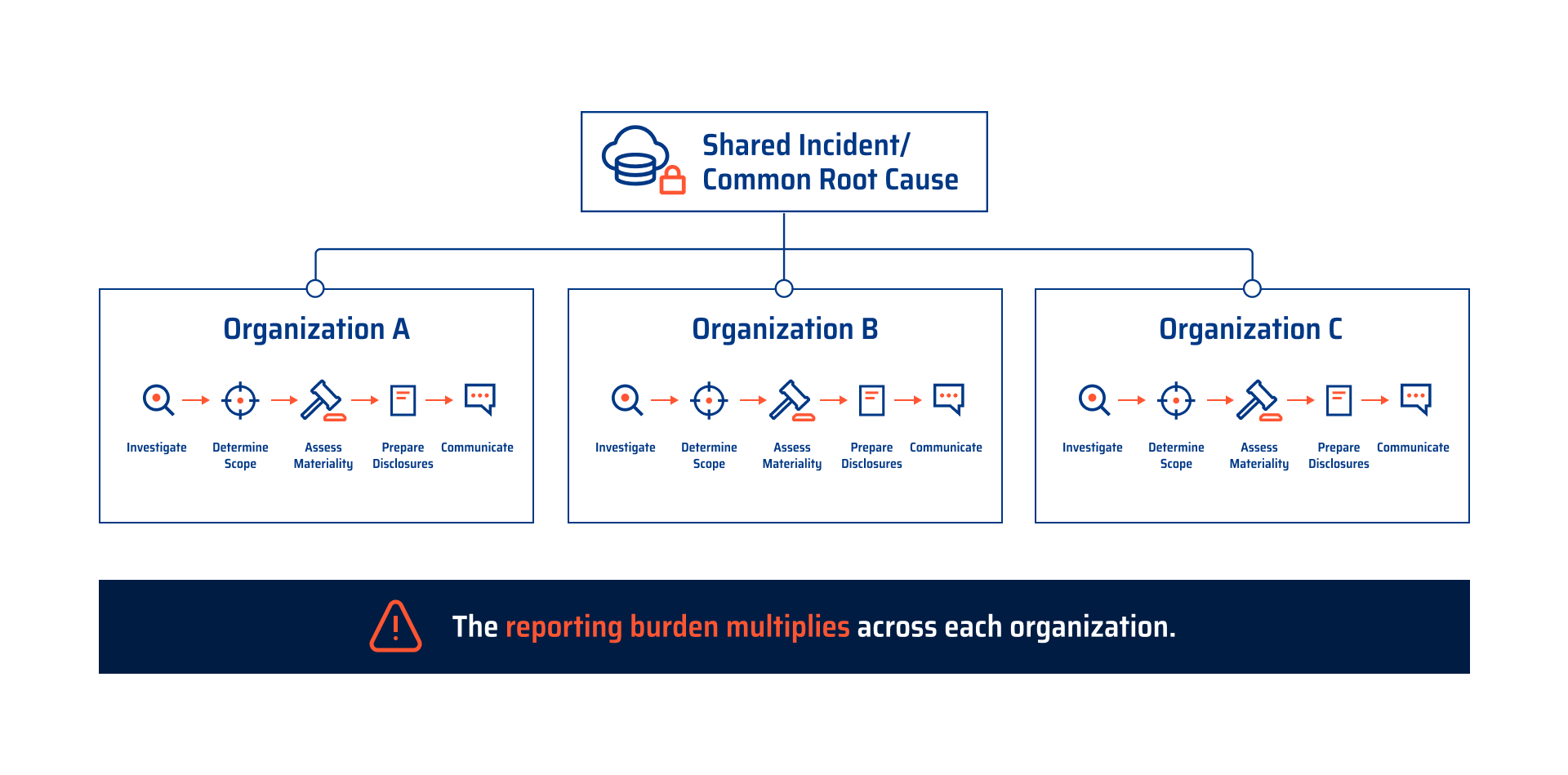
The Snowflake breach illustrates a different model. One root cause affected many organizations, but there was no single reporting process. Each affected company had to investigate independently, determine scope, assess materiality, prepare disclosures, and communicate with customers or regulators.
This is horizontal concurrency. The incident spreads across an ecosystem, but the reporting burden multiplies across each organization.
The research modeled at least 209 obligations across just three affected organizations, while approximately 165 organizations were notified of potential compromise. The true reporting burden was almost certainly far higher, but the exact number matters less than the pattern: each organization activates its own full reporting system.
For leadership teams, the impact is fragmentation. In ecosystem incidents, no one owns the whole picture. Vendors, customers, cloud providers, SaaS platforms, insurers, outside counsel, and regulators may all be operating from different timelines and different evidence. Even when the technical root cause is shared, the legal conclusions and public narratives diverge.
That makes dependency management a core response capability. Organizations need to know what they are waiting on, who owns each obligation, which facts are confirmed, and which assumptions are being carried forward into external statements.
Why Cyber Reporting Is No Longer Human-Scalable
Download the report to see the full impact of each of these incidents, and learn why managing a breach has shifted.
3. Incidents Can Generate More Incidents
The Salesforce breach shows a more dangerous pattern: cascading concurrency.

In this model, the initial incident does not define the final scope. Compromised OAuth tokens provided access to Salesforce environments, but the exposure of secrets, API keys, credentials, and connected-system data created the possibility of secondary compromises across AWS, Snowflake, and other environments.
That means the incident boundary can expand during the investigation. The organization is not simply learning more about a fixed event. It may be discovering new incidents created by the first one.
The impact is scope explosion. Traditional reporting workflows assume that teams can define the incident, determine affected data, map obligations, and proceed. Cascading incidents break that assumption. Every newly discovered system, credential, customer dataset, or downstream exposure can introduce additional reporting questions.
For executives, this creates a governance challenge. What constitutes “the incident”? Should disclosures cover only the initial access, or also downstream impacts? When does a secondary compromise become a separate reportable event? Who owns the boundary between vendor responsibility and customer responsibility?
These are not just technical questions. They determine disclosure strategy, legal exposure, customer trust, and board confidence.
4. Timing Ambiguity Can Be as Dangerous as Incident Scale

The 700Credit incident shows that concurrency is not always created by mega-breach scale. Sometimes it is created by ambiguity.
The key issue was the gap between initial awareness and formal discovery. That distinction may sound narrow, but it can determine when the reporting clocks start. If a regulator later concludes that the clock began at awareness rather than formal discovery, an organization that believed it was compliant may suddenly appear late.
This is definition-driven concurrency. Every obligation is wrapped in a second question: when did the clock actually start?
The impact is defensibility risk. Teams must align security, legal, privacy, executives, and communications around the operative timeline, the legal interpretation of “discovery” or “reasonable determination,” and the evidence supporting that interpretation. If those decisions are not captured in real time, the organization may struggle to defend them later.
For leadership, this finding is especially important because it applies beyond the largest incidents. A mid-scale incident can still exceed manual capacity if the clock-start logic is unclear. The burden is not only producing notices. It is proving why the organization believed each notice was due when it was due.
5. Sometimes the Problem Is Not What You Must Disclose, But What You Cannot Disclose

Salt Typhoon introduces a fifth model: constraint-driven concurrency.
Unlike a typical consumer breach, Salt Typhoon involved telecommunications infrastructure, suspected nation-state activity, law-enforcement coordination, intelligence sensitivity, and national-security constraints. In this environment, the organization may know more than it can safely say. Some reporting may occur through nonpublic channels. Public statements may be intentionally incomplete.
The impact is narrative asymmetry. Different audiences may have different levels of visibility into the truth at the same time. Government partners may receive one level of detail. Executives may receive another. Customers may receive a carefully bound explanation. The public may receive less still.
That does not reduce the need for defensibility. It increases it.
Organizations operating under disclosure constraints still need to preserve a record of what was known, what could not be shared, who approved each communication, and why public disclosure was limited. The risk is not only late disclosure. It is misalignment between private knowledge, regulatory reporting, and the public narrative.
The Executive Takeaway: This Is a Systems Problem
Across all five findings, the conclusion is the same: modern incident reporting has outgrown manual coordination.
The issue is not that legal, security, privacy, and communications teams are not working hard enough. It is that they are being asked to maintain a synchronized state across too many clocks, too many facts, too many stakeholders, and too many artifacts using tools that were not designed for concurrency.
More meetings will not solve this. More templates will not solve this. More spreadsheets will not solve this.
Organizations need a system-driven operating model for incident reporting. That means real-time obligation mapping, a centralized clock ledger, evidence capture, fact consistency across disclosures, workflow ownership across stakeholders, and decision-rationale logging.
The future of cyber incident reporting is not better after-the-fact reconstruction. It is real-time defensibility.
Regulatory concurrency is now a permanent feature of incident response. The organizations that recognize this shift will be able to respond with control, consistency, and confidence. Those that continue to rely on manual coordination will increasingly find that even good-faith efforts are not enough when the reporting system itself is under load.
Incident Reporting Is Now a System-Scale Problem
Learn why defensible reporting depends on better systems, not more meetings