
Why Enterprise Incident Response Needs Its Own Maturity Model
You Find Out How Ready You Are at the Worst Possible Time
Most organizations learn how good their enterprise-wide incident response really is in the middle of a live incident, with executives waiting for answers and a regulatory clock already running. By then, there’s no time left to fix what was never built. A cyber incident response maturity model gives leaders a way to evaluate readiness before a breach does it for them. It looks beyond the existence of a plan and asks whether cyber incident response management (CIRM) can actually function as an enterprise process when the clock is running.
The Cost of Chaos
The stakes for getting this wrong keep rising. IBM’s 2026 Cost of a Data Breach Report puts the global average cost of a breach at $4.99 million—a 12% increase from the prior year and a record high, driven by higher detection, escalation, and lost-business costs. The report also found that organizations making extensive use of AI and automation in security saved an average of $1.93 million per breach compared with organizations using none. Mature programs automate coordination—not only technical tasks. In a 2025 survey of nearly 500 U.S. security executives, Cytactic found that 70% of respondents believed internal misalignment created more chaos during an incident than the attacker itself. During a real incident, analysts, lawyers, privacy teams, communications staff, and executives can all be working hard while operating from different timelines and assumptions. That coordination failure can turn a contained technical event into a much larger business problem.
Why Your Existing Framework Won’t Catch This
Existing security maturity frameworks were not designed to answer this specific question. NIST CSF, the C2M2, CMMC, and SIM3 are all valuable, but they place incident response inside a broader set of governance requirements. That is useful for measuring program maturity. It is less useful for understanding whether an organization can run a live crisis across security, legal, privacy, communications, and the executive team. A plan can exist on paper while ownership is unclear, decisions stall, and the record of what happened becomes difficult to defend later.
A New Category Is Emerging
Cybersecurity incident response management is emerging as a distinct category because that operational gap is real. Gartner included CIRM as a distinct entry in its 2025 Hype Cycle for Security Operations, describing it as giving incident responders dedicated case management and workflow capabilities for tracking resolution and maintaining a forensically sound record, separate from SOAR’s role in automating technical playbook steps. Vendors, including BreachRx, are building around the same need: automating the response itself, not only the technical actions inside it.
What Does a CIRM Maturity Model Measure?
A maturity model gives this discipline a common language. Rather than grading an organization on whether controls exist, it looks at the dimensions that actually determine whether a response holds together:
- Incident execution & accountability
- Cross-functional coordination
- Regulatory & legal readiness
- Documentation & continuous improvement
- Training & operational readiness
Those dimensions, including automation, do not mature uniformly. A company can contain an attack quickly and still have no one certain who to escalate to internally. That mismatch is exactly what a CIRM maturity model should expose.
What Maturity Looks Like During a Real Incident
Consider a ransomware incident discovered at 1:30 a.m. Security isolates the affected systems quickly. Legal is waiting for a reliable data-scope assessment. Privacy is trying to determine which notification obligations may apply. Communications is drafting messaging from an outdated version of events. Executives want to know what happened, what is contained, and which decisions need their approval. Meanwhile, the team is still debating who owns the next update.
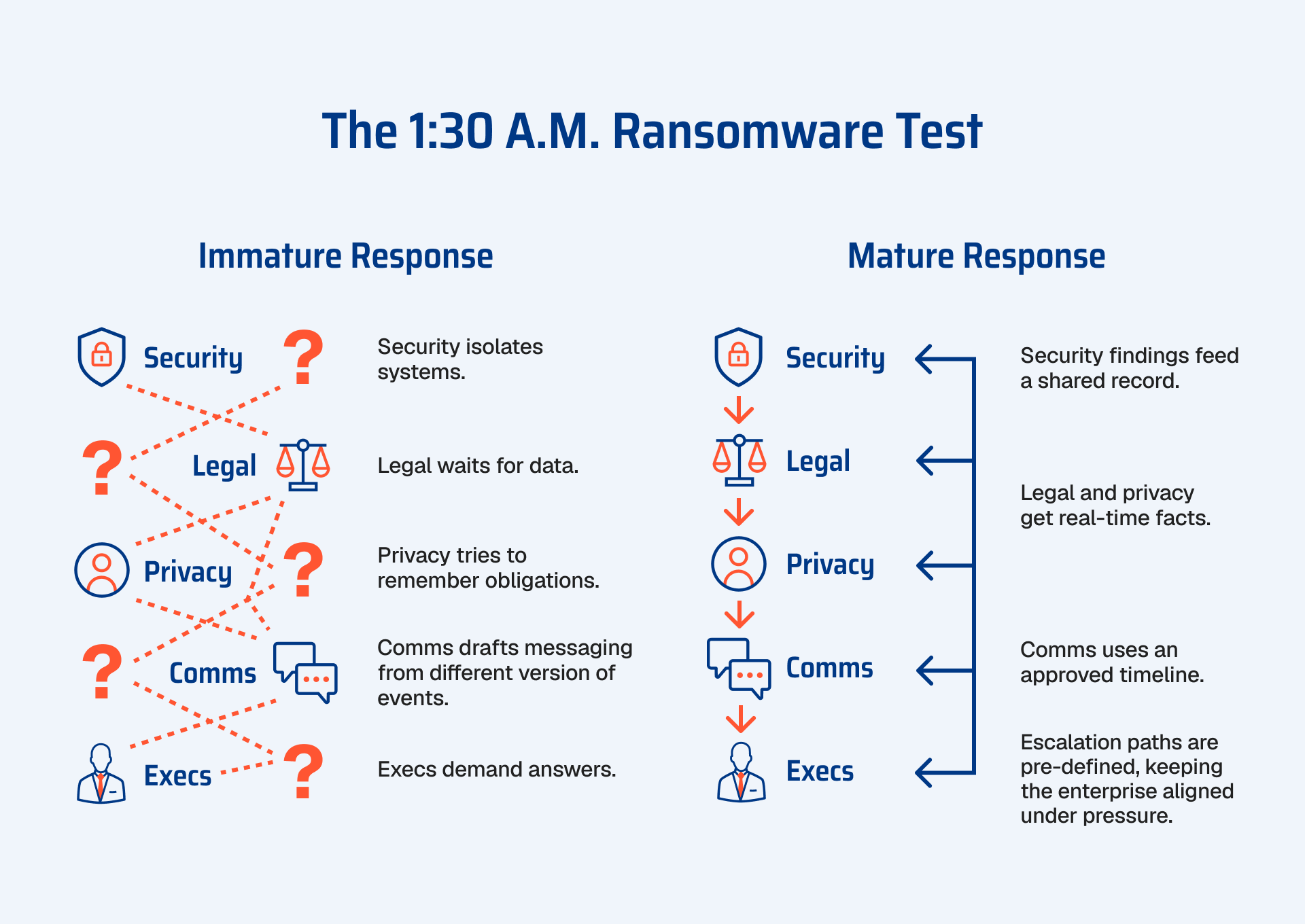
That organization may be technically capable and still operationally immature. In a more mature program, owners and escalation paths are already defined. Security findings feed a shared incident record and automatically route to legal and privacy as evidence changes. Communications work from the same version of events. Deadlines and escalations trigger without manual follow-up. Executives can see open decisions and accountable owners without another side channel. Maturity shows up in the system around the people: automation handles repeatable coordination so people can focus on judgment.
Train Like You Fight
Tabletops are useful, but maturity is not proven by an exercise that bypasses how an incident will actually run. Teams should train on the same owners, workflows, decision gates, escalation paths, and automation they will use in a real event. Let deadlines trigger, facts route, and approvals escalate as designed. That exposes broken handoffs and manual workarounds before an incident does. Training becomes a live test of the response operating model.
What are the Four Levels of a Cyber Incident Response Maturity Model?
Most programs move through a similar progression. The labels matter less than how capabilities become standardized, measurable, and automated:
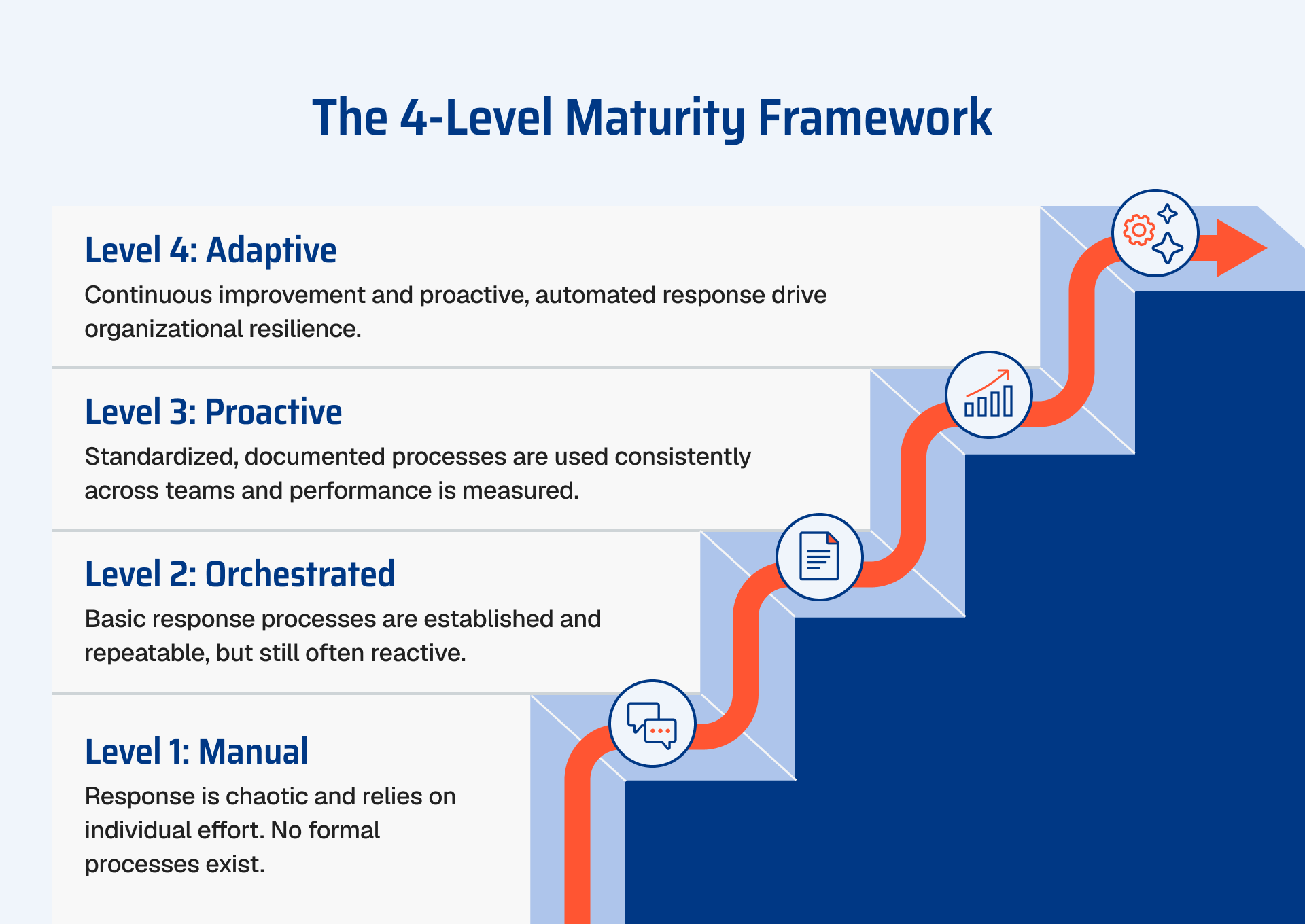
An organization will not be Level 4 everywhere. Technical containment may be highly mature while response procedures are limited or regulatory readiness remains manual. The value of the model is seeing those differences clearly—and automating repeatable coordination as capabilities mature.
Clarity Before the Clock Starts
A cyber incident response maturity model gives leaders a path to answer a question most organizations otherwise leave for the incident itself: can we run this response as one enterprise?
The goal is not a perfect score. It is to know where ownership is strong, where coordination will break, what has not been tested realistically, and which manual steps should be automated before those weaknesses are tested in public.
You should know how your organization will respond before an incident puts that answer on display. BreachRx’s CIRM Buyer’s Guide breaks down what to look for in a platform designed to support that level of readiness.