

7 Ways to Improve Your Cybersecurity Tabletop Exercises
Tabletop exercises should do more than review your incident response plan or ask participants what they would do. Rather, they should demonstrate whether your organization can establish command, coordinate across functions, make defensible decisions, and execute under pressure.
That standard is increasingly important as offensive AI increases the speed, scale, and complexity of attacks. Security teams may detect suspicious activity quickly, but an incident still requires legal, privacy, communications, IT, executives, and outside advisers to work from the same facts while the situation and reporting obligations change.
The strongest exercise programs must mirror the way your organization operates during a live event. Seven recommendations can help teams move from discussion-based tabletops to demonstrated operational readiness.
Move from discussion-based planning to demonstrated operational readiness
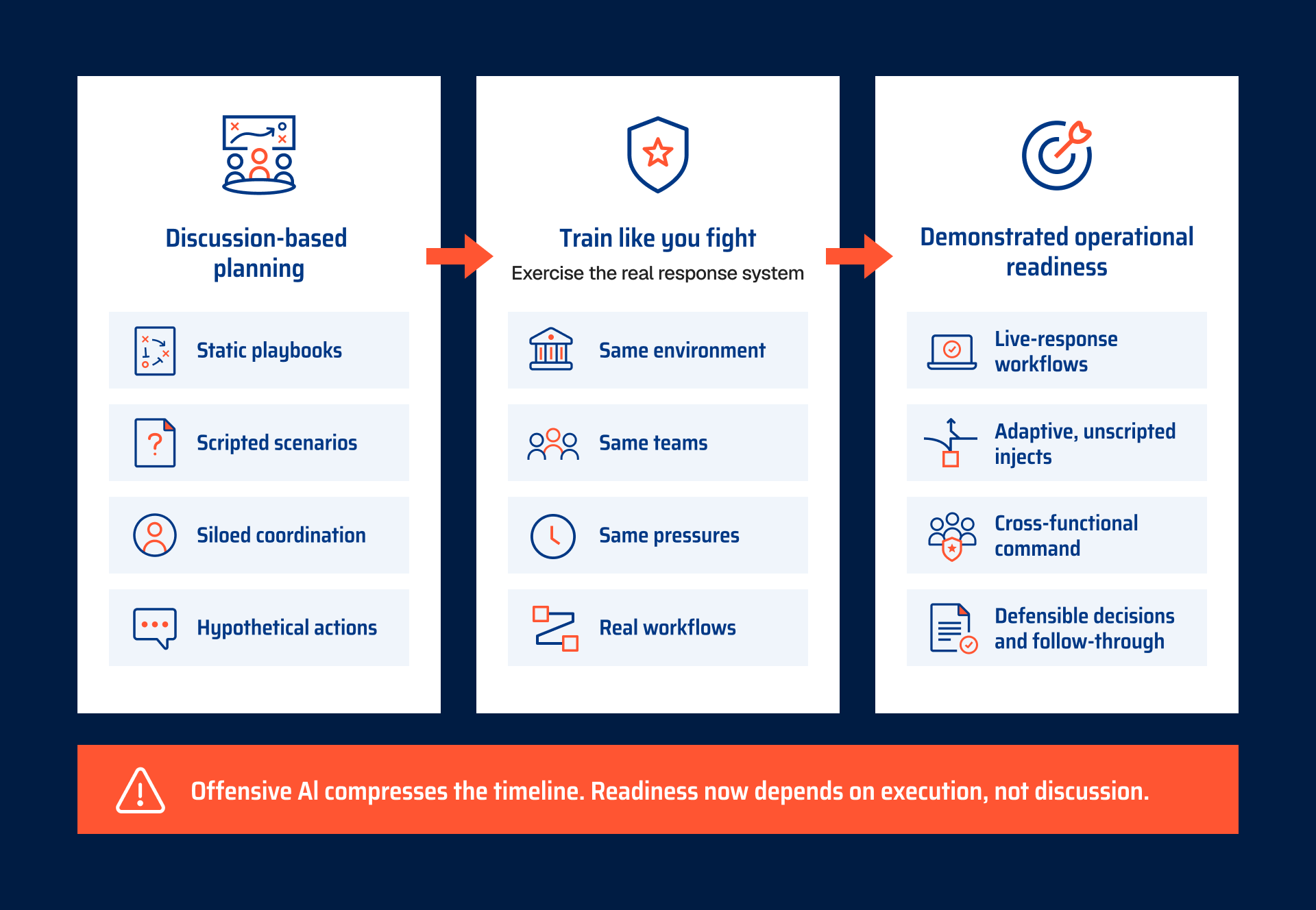
Seven ways to improve cybersecurity tabletop exercises include:
1. Train in the same environment used during a real incident
Slide decks and spreadsheets can support an exercise, but they do not fully test live response. Teams should practice with the same roles, permissions, workflows, task assignments, approvals, communications, and reporting structures they will rely on during an incident. This “train like you fight” approach tests the response system, not only knowledge of the plan.
How BreachRx can help: Teams exercise inside Rex using the same governed workflows, permissions, and reporting structures they’ll rely on live, so the first time anyone finds out access is broken isn’t during the incident that matters most.
2. Turn static playbooks into executable workflows
A written playbook is a starting point, but a fast-moving incident will not follow a predictable sequence. Exercises should test whether teams can assign owners, manage dependencies, route approvals, and adapt work as facts change.
How BreachRx can help: Rex converts playbooks into role-based workflows with clear ownership, dependencies, escalations, approvals, and a time-stamped record that shows, afterward, who decided what and why.
3. Exercise the full enterprise response team
Cyber incidents rarely remain inside the SOC. Include security, legal, privacy, IT, communications, business continuity, executives, and relevant external partners. Give each function realistic activation triggers and responsibilities, and require everyone to work from a common operating picture.
How BreachRx can help: Rex brings internal teams and outside advisers into one coordinated response process while preserving appropriate permissions and privileged workstreams.
4. Make scenarios dynamic instead of scripted
Real attackers change tactics and create uncertainty. Scenarios should respond to participant decisions with adaptive injects, incomplete evidence, synthetic communications, new attack paths, or changing business impact rather than follow a fixed sequence.
How BreachRx can help: RexAI® Maestro coordination agent can accelerate scenario development and adaptive injects while keeping consequential decisions with human leaders.
5. Require teams to perform real response actions
Discussion can conceal broken processes. Participants should open a secure out-of-band channel, assign work, retrieve relevant documents, route approvals, draft stakeholder updates, and record decision rationale. Real execution exposes access problems, unclear authority, and workflow gaps.
How BreachRx can help: Rex lets participants perform and document these actions in the same environment they will use during an actual event, including secure out-of-band communications.
6. Test regulatory concurrency and defensible decisions
One incident can trigger overlapping regulatory, contractual, customer, insurer, and board obligations before the facts are stable. Exercises should require teams to identify triggers, assign owners and deadlines, update requirements as scope changes, and document the rationale behind reporting decisions.
How BreachRx can help: Rex and Cyber RegScout® connect evolving incident facts to potential obligations, deadlines, owners, approvals, and decision rationale.
7. Connect every exercise to continuous improvement
Findings should not disappear into an after-action report. Assign corrective actions, update workflows and playbooks, clarify ownership, and retest important gaps. Combine frequent micro-exercises, cross-functional tabletop exercises, and periodic enterprise simulations.
How BreachRx can help: Exercise findings can flow directly into revised Rex workflows, updated playbooks, assigned corrective actions, and future exercises, so every finding becomes capability instead of a line in a report nobody reopens.
The objective is to prove that the enterprise can establish command, coordinate action, make decisions, and keep the trust of everyone watching how it handles the moment, while the attack, the facts, and the obligations are all still changing.
Train Like You Fight With BreachRx
BreachRx connects planning, exercises, and live response in the Rex Platform, allowing teams to practice the processes they will use during a real event. Rex AI also helps create adaptive scenarios, summarize results, and turn findings into improvements.
Book a demo to learn how the Rex Platform can help your organization train like it fights and prove, when it counts, that it still deserves the trust it’s asking people to place in it.
Ready to Strengthen Your Cybersecurity Tabletop Exercises?