
Cyber Incident Response
By: Martin Johnson, Head of Product Marketing, BreachRx · Last updated: Aug 25, 2026
What is Cyber Incident Response?
Cyber incident response is the coordinated process an organization uses to identify, investigate, contain, remediate, and recover from cybersecurity incidents such as data breaches, ransomware attacks, compromised accounts, unauthorized system access, and other security events.
Effective cyber incident response extends beyond technical containment. A significant incident can quickly require decisions from security, IT, legal, privacy, communications, compliance, executive leadership, outside counsel, forensic investigators, insurers, and other stakeholders. These teams must establish reliable facts, determine responsibilities, assess business and regulatory impact, make time-sensitive decisions, and maintain a defensible record of what happened and how the organization responded.
Why is Cyber Incident Response Important?
Cyber incidents can create operational, financial, legal, regulatory, and reputational consequences simultaneously — often across multiple teams at once:
- Security investigates the attack and contains affected systems
- Legal and privacy assess regulatory and notification requirements
- Communications prepares stakeholder messaging
- Executives make decisions about business operations, disclosure, or recovery
Without a structured incident response process, organizations often fall back on disconnected spreadsheets, email, messaging platforms, conference calls, and manual status updates. That fragmentation can result in conflicting facts, unclear ownership, missed deadlines, duplicated work, and difficulty reconstructing why decisions were made.
A mature cyber incident response program gives teams a repeatable process for acting quickly while maintaining coordination, accountability, and evidence throughout the incident.
What Are the Steps in Cyber Incident Response?
Incident response is often described as a series of stages, although modern frameworks increasingly treat these activities as part of a continuous cybersecurity risk management process.
- Prepare and Govern
Organizations establish incident response policies, plans, roles, escalation procedures, communications processes, decision authorities, and regulatory requirements before an incident occurs. Teams should regularly exercise those processes so participants understand their responsibilities under pressure. - Detect and Analyze
Security teams identify suspicious activity and determine whether it represents a cybersecurity incident. Responders investigate the nature of the activity, affected systems, threat actor behavior, data exposure, business impact, and potential scope. - Contain and Remediate
Responders take action to limit further damage, isolate compromised systems or accounts, remove malicious activity, address vulnerabilities, preserve evidence, and prevent the attacker from regaining access. - Coordinate Enterprise Decisions
As technical facts develop, security, legal, privacy, communications, IT, executives, and other stakeholders determine what actions are required. These decisions may include shutting down systems, engaging outside counsel or forensic providers, notifying insurers, assessing materiality, evaluating regulatory obligations, or communicating with customers and employees. - Recover
Affected systems and business operations are restored safely. Teams validate that threats have been removed, monitor for recurrence, prioritize critical services, and maintain communication with stakeholders as recovery progresses. - Learn and Improve
Organizations capture lessons learned, identify gaps in plans and controls, update response procedures, and incorporate those improvements into future exercises and incident response activities.
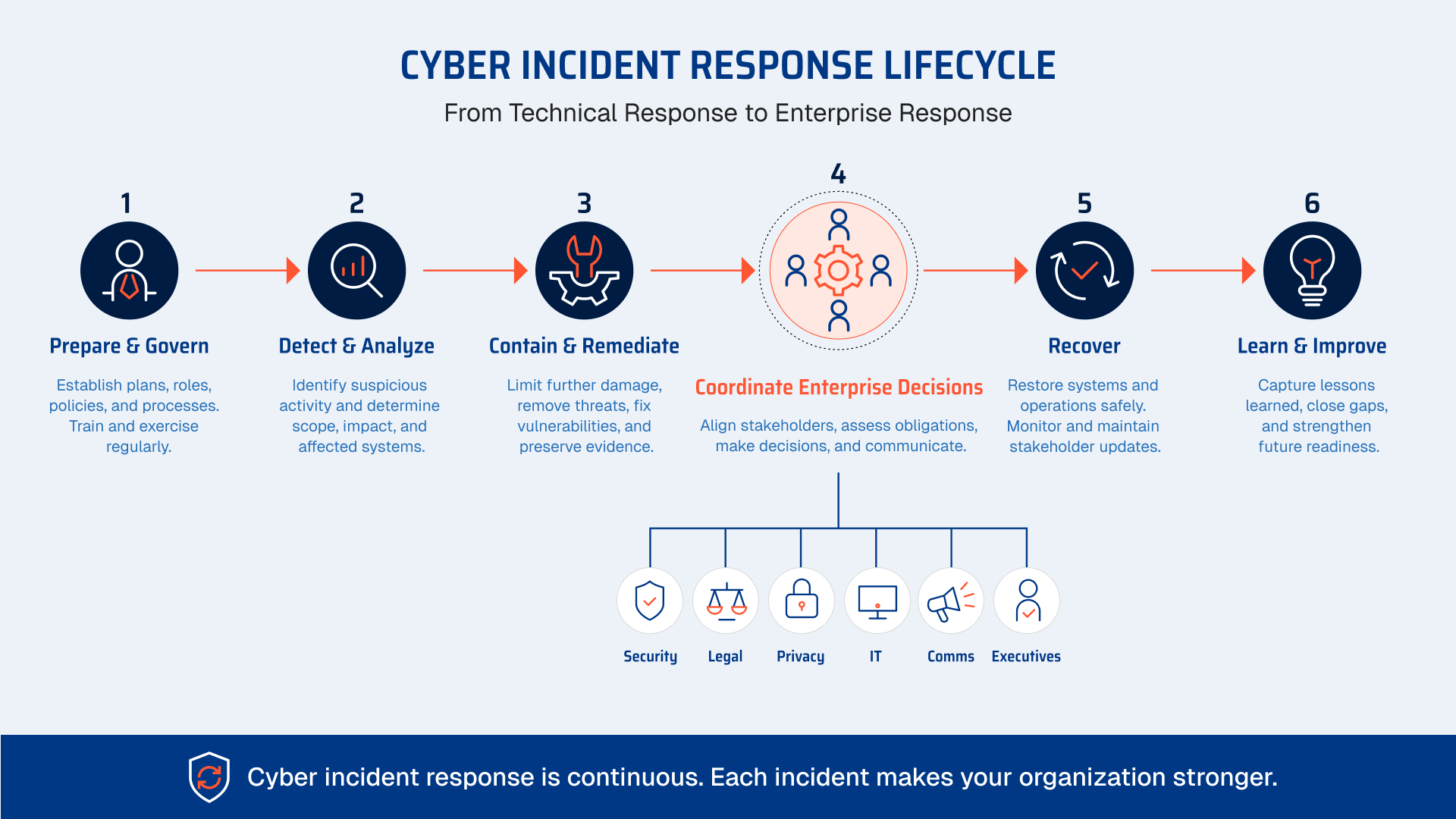
Figure 1. Cyber incident response lifecycle: from technical response to enterprise coordination.
What Is a Cyber Incident Response Plan?
A cyber incident response plan defines how an organization will identify, escalate, coordinate, contain, communicate, and recover from cybersecurity incidents. It typically establishes:
- Incident classifications
- Roles and responsibilities
- Escalation paths
- Decision authorities
- Communications procedures
- Evidence requirements
- Regulatory considerations
- Recovery processes
An effective plan should extend beyond the security team. It should define how legal, privacy, communications, IT, compliance, executives, and external partners engage as an incident escalates, as well as who owns critical decisions and approvals.
A written plan alone does not demonstrate readiness. Organizations should regularly test whether the plan works under realistic conditions through incident response exercises that rehearse escalation, ownership, decision-making, communications, and cross-functional coordination. Lessons from those exercises should then be incorporated into response workflows and procedures.
What Cyber Incident Response Frameworks Do Organizations Use?
Several widely adopted cybersecurity frameworks can help organizations structure and improve cyber incident response.
NIST Cybersecurity Framework and NIST SP 800-61
The NIST Cybersecurity Framework (CSF) 2.0 organizes cybersecurity risk management around six functions: Govern, Identify, Protect, Detect, Respond, and Recover.
NIST’s current incident response guidance, NIST Special Publication 800-61 Revision 3, integrates incident response throughout those functions. Govern, Identify, and Protect help organizations prepare for incidents and reduce their impact, while Detect, Respond, and Recover support identifying, managing, containing, eradicating, and recovering from active incidents.
This reflects an important evolution in incident response: response is not simply something a security team begins after an alert. Governance, preparation, cross-functional responsibilities, communications, reporting, and continuous improvement are part of an organization’s overall ability to respond effectively.
SANS Incident Response Framework
The SANS incident response framework provides a practical six-step approach commonly summarized as Preparation, Identification, Containment, Eradication, Recovery, and Lessons Learned, or PICERL.
The model gives incident responders a straightforward structure for moving from preparation and initial investigation through technical containment, recovery, and post-incident improvement. NIST and SANS are often used together: SANS provides a tactical incident-handling sequence, while NIST places response activities within a broader cybersecurity risk-management and governance framework.
MITRE ATT&CK
MITRE ATT&CK® is a globally accessible knowledge base of adversary tactics and techniques based on real-world observations. It is not itself an incident response lifecycle, but it gives security teams a common framework for understanding how attackers behave.
During an incident, responders can use the MITRE ATT&CK Enterprise Matrix to help characterize observed behavior, investigate how an attacker gained and maintained access, identify related activity, anticipate potential next steps, and inform detection, containment, and remediation decisions.
NIST, SANS, and MITRE therefore serve complementary purposes. NIST provides a broader structure for cybersecurity risk management and incident response, SANS offers a practical incident-handling process, and MITRE ATT&CK helps technical teams understand and investigate adversary behavior.
What Tools Support Cyber Incident Response?
Cyber incident response typically depends on multiple technologies rather than a single tool. These generally fall into three categories:
- Detection and investigation: SIEM, EDR, XDR, SOAR, threat intelligence, and forensic tools. These help security teams detect suspicious activity, investigate threats, understand attacker behavior, and contain compromised systems.
- Remediation and recovery: IT service management and infrastructure tools that support rebuilding and restoring affected systems.
- Coordination: Communications and collaboration tools that connect the people involved in the response.
These tools are critical, but significant incidents also create work outside the technical security stack. Organizations must coordinate legal and privacy analysis, regulatory obligations, executive decisions, communications, approvals, evidence, external stakeholders, and reporting deadlines.
Cybersecurity Incident Response Management (CIRM) addresses this broader coordination layer. Rather than replacing SIEM, EDR, XDR, SOAR, or forensic tools, CIRM connects technical response with the enterprise-wide decisions and workflows surrounding it.
Who Is Involved in Cyber Incident Response?
Modern cyber incident response is inherently cross-functional. Depending on the incident, participants may include:
- Security and incident response teams to investigate threats, determine scope, preserve evidence, and contain malicious activity.
- IT and technology teams to isolate, restore, rebuild, or validate affected systems and services.
- Legal and outside counsel to evaluate legal obligations, privilege, contractual responsibilities, law-enforcement involvement, and potential liability.
- Privacy and compliance teams to determine whether affected information triggers notification or reporting requirements.
- Communications teams to coordinate accurate messaging to employees, customers, partners, media, and other stakeholders.
- Executives and business leaders to make decisions involving business operations, risk, disclosure, recovery priorities, and resources.
- External partners such as forensic investigators, insurers, breach counsel, cloud providers, and other specialists.
Effective response depends on keeping these participants aligned around the same facts, responsibilities, decisions, and incident timeline.
How Do Regulatory and Governance Requirements Affect Cyber Incident Response?
Cyber incident response increasingly includes regulatory assessment, governance decisions, and external reporting alongside technical investigation and containment. Organizations can face multiple obligations with different triggers, deadlines, audiences, and required information—sometimes before investigators have established a complete picture of what happened.
Common Cyber Incident Reporting Timelines
Examples of major reporting requirements include:
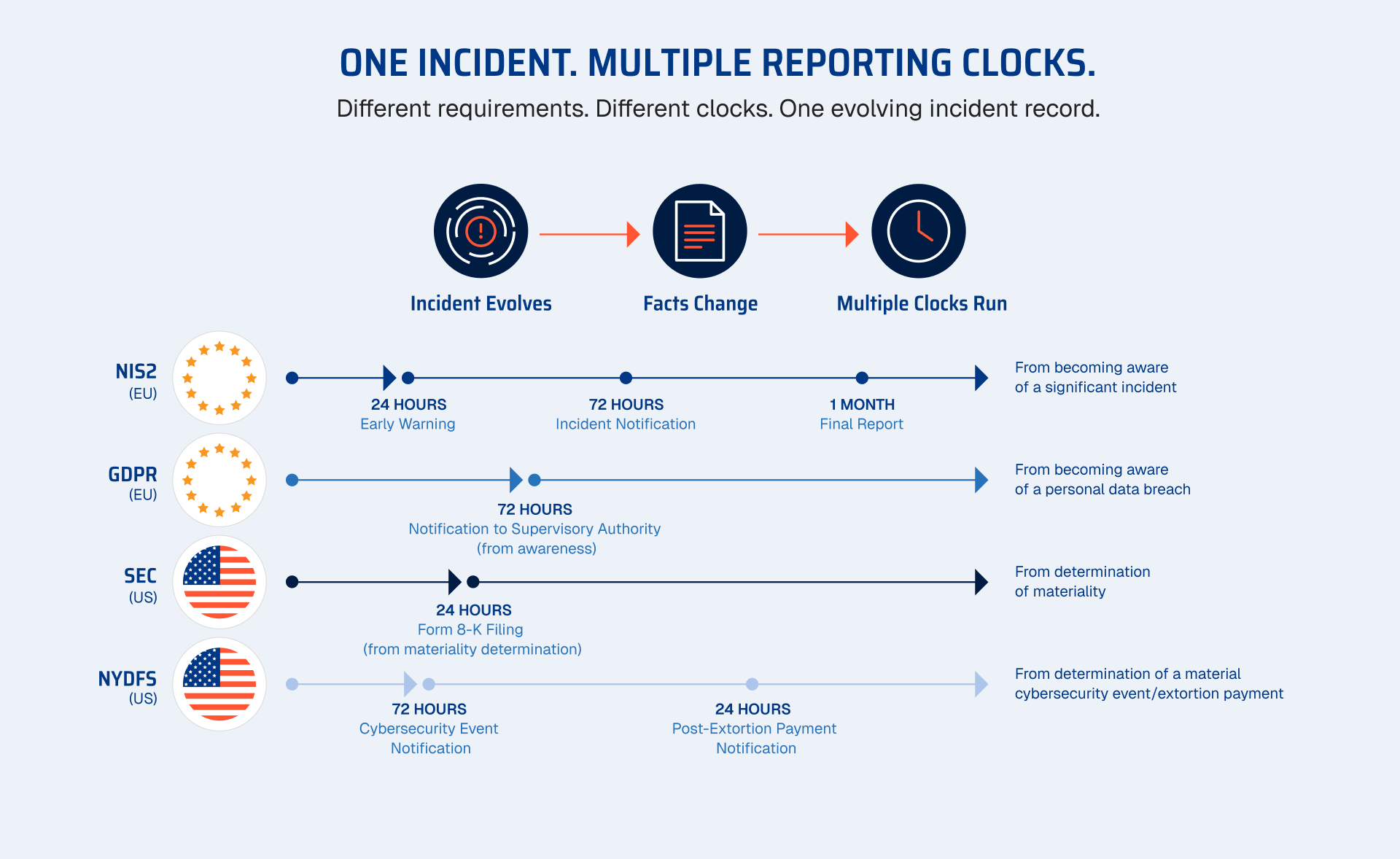
Figure 2. One incident can trigger multiple reporting clocks with different regulatory deadlines and triggers.
| Regulation | Illustrative Reporting Timeline |
|---|---|
| NIS2 Directive | Covered essential and important entities generally follow a staged process for significant incidents: an early warning within 24 hours of becoming aware, an incident notification within 72 hours, and a final report generally within one month. Specific obligations are implemented through national law. |
| GDPR Article 33 | Controllers generally must notify the appropriate supervisory authority of a qualifying personal data breach without undue delay and, where feasible, within 72 hours after becoming aware of it, unless the breach is unlikely to result in a risk to individuals’ rights and freedoms. |
| SEC Item 1.05 Form 8-K | U.S. public companies generally must disclose a material cybersecurity incident within four business days after determining the incident is material. The SEC requires the materiality determination to be made without unreasonable delay. |
| NYDFS 23 NYCRR Part 500 | Covered entities generally must notify NYDFS within 72 hours of determining that a reportable cybersecurity event occurred. Separate requirements include notification within 24 hours of an extortion payment. |
These examples illustrate why cyber incident response cannot be separated from governance and regulatory coordination. An organization may still be establishing the technical scope of an incident while simultaneously determining whether NIS2, GDPR, SEC, state, sector-specific, contractual, or other requirements apply.
The clocks also do not all start at the same point. GDPR focuses on awareness of a qualifying personal data breach. NIS2 establishes staged reporting after awareness of a significant incident. The SEC’s Form 8-K deadline is triggered by a company’s determination that an incident is material rather than by initial discovery.
As incidents cross jurisdictions and regulatory regimes, organizations may therefore need to manage multiple reporting clocks while the underlying facts continue to change. Maintaining a shared incident record—including what was known, when it became known, which obligations were evaluated, and which decisions were made—becomes important for both timely reporting and post-incident defensibility.
BreachRx research on regulatory concurrency in cyber incident reporting found that major cyber incidents can create dozens or hundreds of simultaneous reporting obligations across regulators and other external stakeholders. The resulting challenge is not simply knowing what regulations say; it is coordinating facts, deadlines, decisions, approvals, and reporting across the organization as the incident evolves.
For a deeper examination of this challenge, download the BreachRx report, Regulatory Concurrency: Why Cyber Incident Reporting Has Become a System-Scale Problem.
Reporting requirements depend on the organization, jurisdiction, industry, incident, and applicable national or sector-specific law. The examples above are illustrative and are not legal advice.
What Is the Difference Between Cyber Incident Response and Cybersecurity Incident Response Management?
Cyber incident response traditionally emphasizes the technical activities required to investigate, contain, eradicate, and recover from a cybersecurity incident.
Cybersecurity Incident Response Management (CIRM) extends that process across the enterprise. CIRM coordinates the people, workflows, decisions, regulatory obligations, communications, evidence, approvals, and deadlines surrounding the technical response.
The distinction becomes especially important during significant incidents. Containing malware or disabling a compromised account may be primarily technical activities, but determining materiality, managing regulatory clocks, approving customer communications, documenting executive decisions, preserving privilege, and maintaining a common incident record require enterprise-wide coordination.
CIRM provides the management and governance layer that connects those activities into a coordinated, repeatable, and defensible response.
Organizations evaluating how to operationalize that model can use the BreachRx Buyer’s Guide for Cybersecurity Incident Response Management Platforms to assess workflows, cross-functional coordination, regulatory capabilities, AI, evidence capture, integrations, and other core CIRM requirements.
How Does BreachRx Help with Cyber Incident Response?
BreachRx Cybersecurity Incident Response Management helps organizations manage cyber incident response as a governed, enterprise-wide business process rather than an improvised series of actions during a crisis.
The Rex Platform™ provides structured workflows, an enterprise system of record, continuous evidence capture, privileged communications, embedded regulatory intelligence, and Rex AI® in one operational environment. Security, legal, privacy, IT, communications, compliance, and executive teams can work from a shared incident record while responsibilities, deadlines, decisions, evidence, and regulatory obligations are tracked as the incident evolves.
For regulatory response, Cyber RegScout® brings regulatory intelligence directly into the incident workflow, helping teams identify potentially applicable requirements, evaluate changing incident facts, and manage reporting and disclosure obligations.
BreachRx AI Tabletop Exercises allow organizations to rehearse incident response using the same workflows used during live incidents. Teams can test escalation paths, ownership, cross-functional decision-making, and response procedures, then translate lessons learned into operational improvements.
Rather than replacing SIEM, SOAR, EDR, XDR, forensic, or other technical security technologies, Rex extends incident response beyond technical containment. It coordinates the enterprise-wide work required to turn security findings into timely, managed, and defensible action.
For a deeper look at the operating model, read the BreachRx whitepaper The Rex Platform™: The Command Center for Incident Response in the New World of AI-Accelerated Exploits. Organizations evaluating CIRM technology can also download the CIRM Buyer’s Guide, while teams exploring the role of AI in response can read Agentic AI for Incident Response Management in the Age of AI-Driven Exploits.
Frequently Asked Questions
1. When should cyber incident response formally begin?
Cyber incident response should begin when suspicious activity requires investigation, containment, escalation, or coordinated decision-making beyond routine security operations. Organizations should not wait for every fact to be confirmed before activating the appropriate response process.
2. How do organizations determine whether a cyber event is an incident?
Organizations typically evaluate the nature, scope, potential impact, affected systems or information, and need for escalation. Defined severity criteria and incident classification procedures help teams determine when an event requires formal incident response.
3. What makes cyber incident response break down?
Cyber incident response often breaks down when teams operate from different facts, responsibilities are unclear, decisions are scattered across multiple tools, or regulatory and business requirements are managed separately from the technical response.
4. Is cyber incident response only a security responsibility?
No. Security teams lead many technical response activities, but significant incidents commonly require participation from IT, legal, privacy, communications, compliance, executives, and external specialists.
5. What should a cyber incident response plan include?
A cyber incident response plan should define incident classifications, roles and responsibilities, escalation paths, decision authorities, communications procedures, evidence requirements, regulatory considerations, containment and recovery processes, and how lessons learned will be incorporated into future response activities.
6. What is the difference between NIST, SANS, and MITRE for incident response?
NIST provides broad cybersecurity risk-management and incident-response guidance. SANS provides a tactical six-step incident-handling model—Preparation, Identification, Containment, Eradication, Recovery, and Lessons Learned. MITRE ATT&CK
7. Why is documentation important during cyber incident response?
A reliable incident record helps teams establish what was known, what actions were taken, who approved key decisions, and when those decisions occurred. That documentation supports internal reviews, regulatory reporting, legal analysis, customer inquiries, audits, and post-incident improvement.
8. What tools are used for cyber incident response?
Security teams commonly use SIEM, EDR, XDR, SOAR, threat intelligence, forensic, and related security technologies to detect, investigate, contain, and remediate threats. Enterprise response may also require CIRM, communications, regulatory intelligence, evidence-management, and workflow capabilities to coordinate the broader business response.
9. How is CIRM different from traditional incident response tools?
Traditional tools such as SIEM, EDR, XDR, and SOAR primarily support detection, investigation, containment, and technical automation. CIRM coordinates the broader enterprise response across security, legal, privacy, IT, communications, compliance, and leadership, including decisions, obligations, evidence, approvals, and reporting.