
AI Is Breaking Traditional Incident Response. Enterprise Incident Response Is the New Standard.
For years, cyber incident response has been treated as a technical discipline: identify the threat, contain the damage, recover the environment, and document what happened. That model still matters. Security and IT teams will always need strong detection, investigation, containment, and remediation capabilities.
But AI is changing the shape of incidents faster than traditional response models can absorb. The issue is not only that attacks are getting more sophisticated. Incidents are becoming faster, more numerous, more interconnected, and more consequential across the business. A security event can simultaneously become a legal, customer, operational, board, insurer, and regulator issue before the organization has a complete picture of what happened.
That is where traditional incident response begins to break down. Most organizations have invested heavily in tools that help security teams detect and investigate threats. Far fewer have built an operating model that helps the enterprise coordinate decisions, obligations, approvals, communications, and evidence while the facts are still changing.
BreachRx was built for that gap. It does not replace detection tools, forensic teams, counsel, executives, or communications leaders. BreachRx provides a governed operating layer for moving together when an incident stops being just a technical event and becomes an enterprise incident response event.
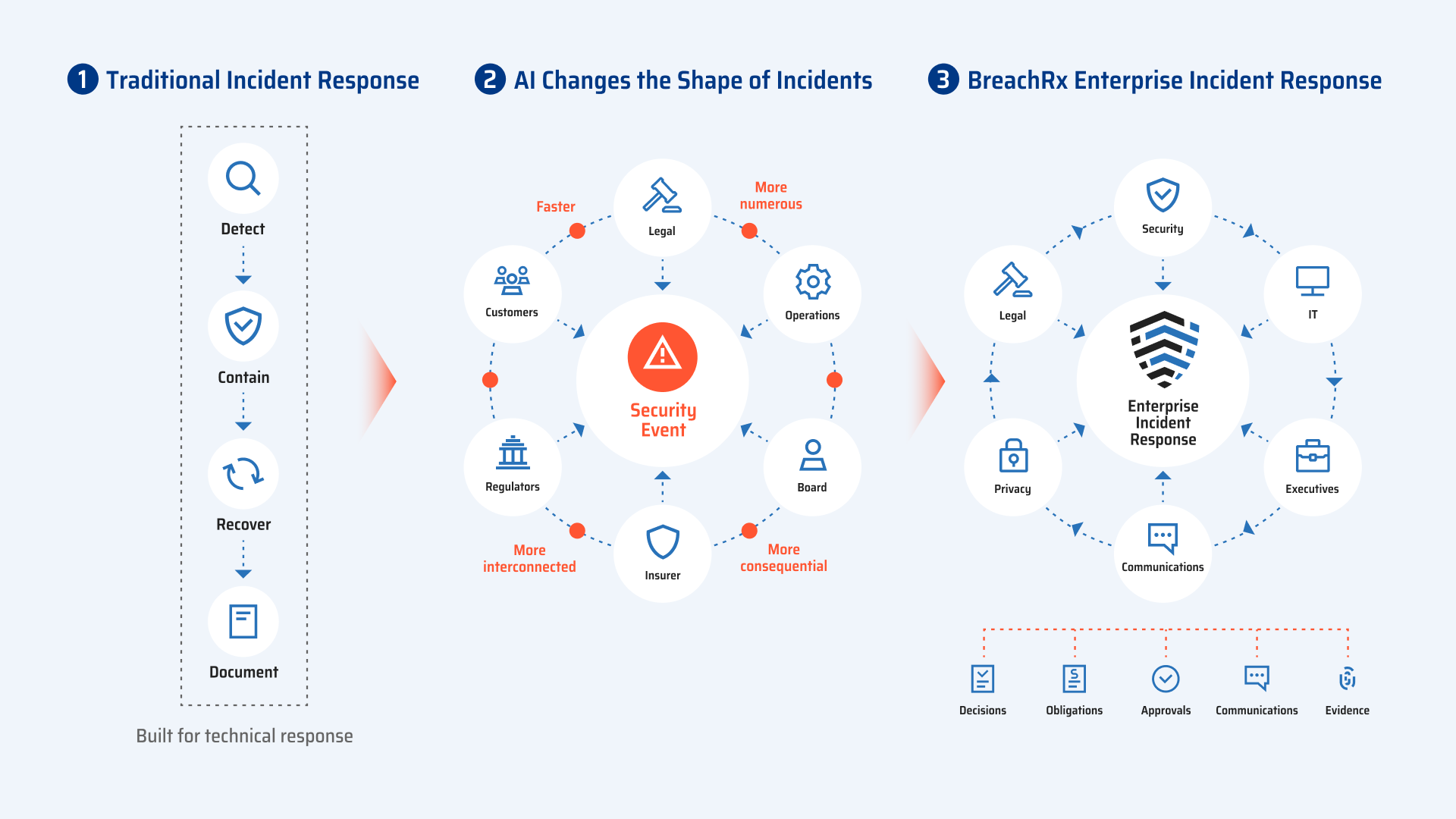
AI expands the surface area of response
The first challenge is complexity. Modern incidents do not stay neatly inside the SOC. A compromised identity, SaaS integration, API key, or AI agent can quickly create uncertainty across the business.
Consider a compromised employee account connected to a customer support platform. Security may need to determine how the account was accessed and whether the attacker moved laterally. Privacy needs to know whether personal data was exposed. Legal needs enough facts to assess notification obligations. Customer success may need to prepare for outreach. Executives may need to understand business impact before the facts are complete. The challenge is not just technical containment. It is coordinating many teams around a moving set of facts.
Security tools are essential to that process, but they were not built to manage the full enterprise response. They help teams detect threats, investigate activity, open cases, and take containment actions. They do not typically manage legal review, privacy analysis, communications approvals, customer obligations, executive decisions, and regulatory requirements in one governed workflow.
That leaves many organizations stitching the response together manually. Updates move through Slack, email, bridge calls, ticket queues, outside counsel summaries, and shared documents. Each function may be working hard, but no one has a complete view of what has been decided, what remains uncertain, who owns the next step, or what evidence supports the current position.
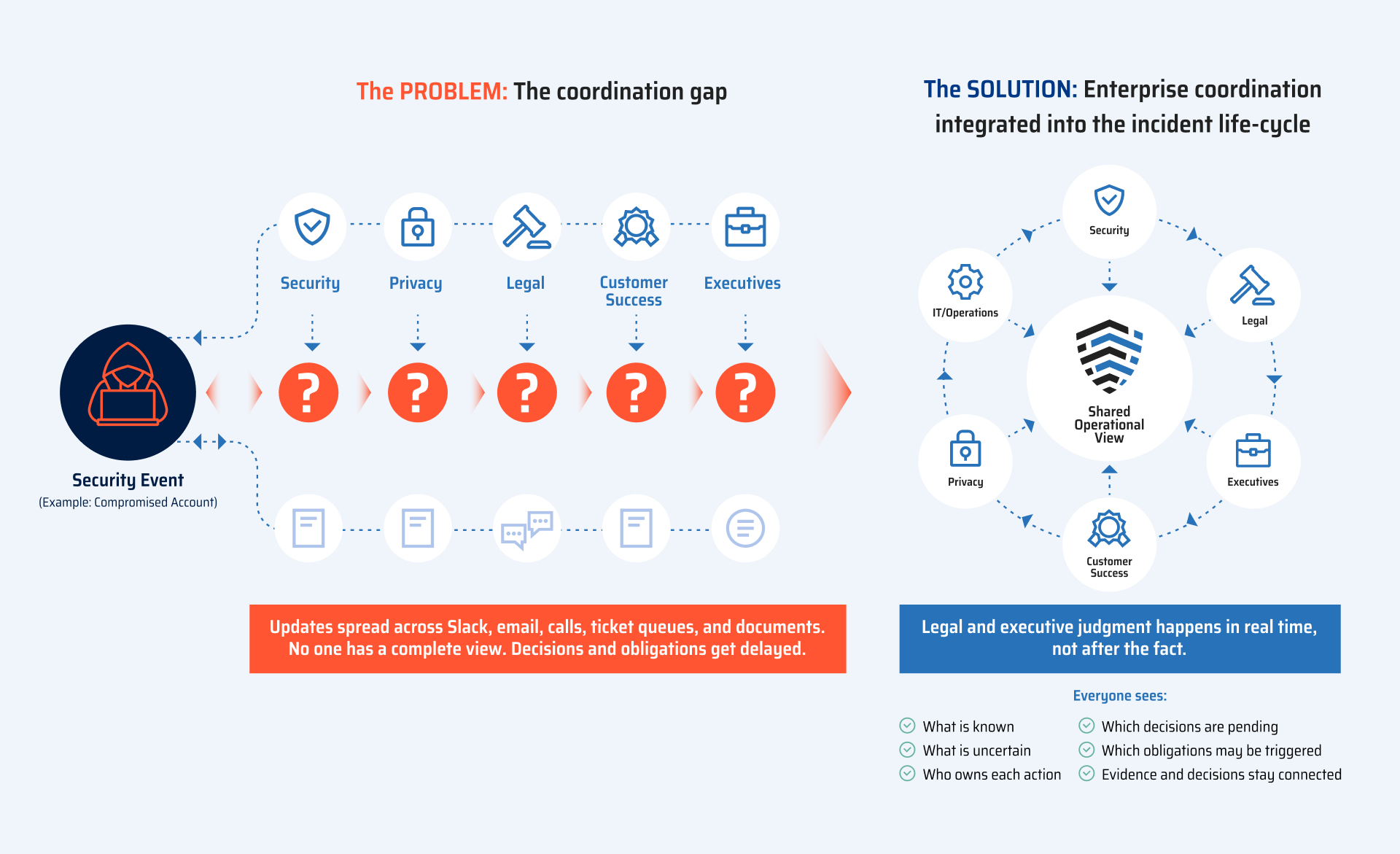
BreachRx brings enterprise coordination into the incident lifecycle from the start. Rex gives teams a shared operational view of the incident as it unfolds. Teams can see what is known, what is still uncertain, who owns each action, which decisions are pending, and which obligations may be triggered. Legal and executive judgment are connected to the work as it happens, rather than reconstructed after the fact.
AI changes the speed, scale, and simultaneity of incidents
The second challenge is acceleration. Offensive AI is helping adversaries move faster across the attack lifecycle: research targets, craft more convincing lures, automate reconnaissance, generate exploit variants, test defensive gaps, and adapt tactics with much less manual effort. What once required specialized expertise and time can increasingly be compressed, repeated, and scaled by less sophisticated actors.
That changes the workload for responders. Organizations are not just facing one faster incident at a time. They may face more events, more false starts, more ambiguous signals, and more simultaneous investigations. AI can increase the pressure on every aspect of response: triage, escalation, impact assessment, containment, executive reporting, disclosure analysis, and customer communication.
Traditional incident response was not designed for that level of concurrency. Many programs were built around high-touch coordination among specialized experts, using bridge calls, shared documents, ticket queues, and manual follow-up across Slack, email, counsel, IT, privacy, and business teams. That can work when the incident load is low and the facts are relatively stable. It becomes fragile when several impacts are unfolding at once and each requires cross-functional judgment.
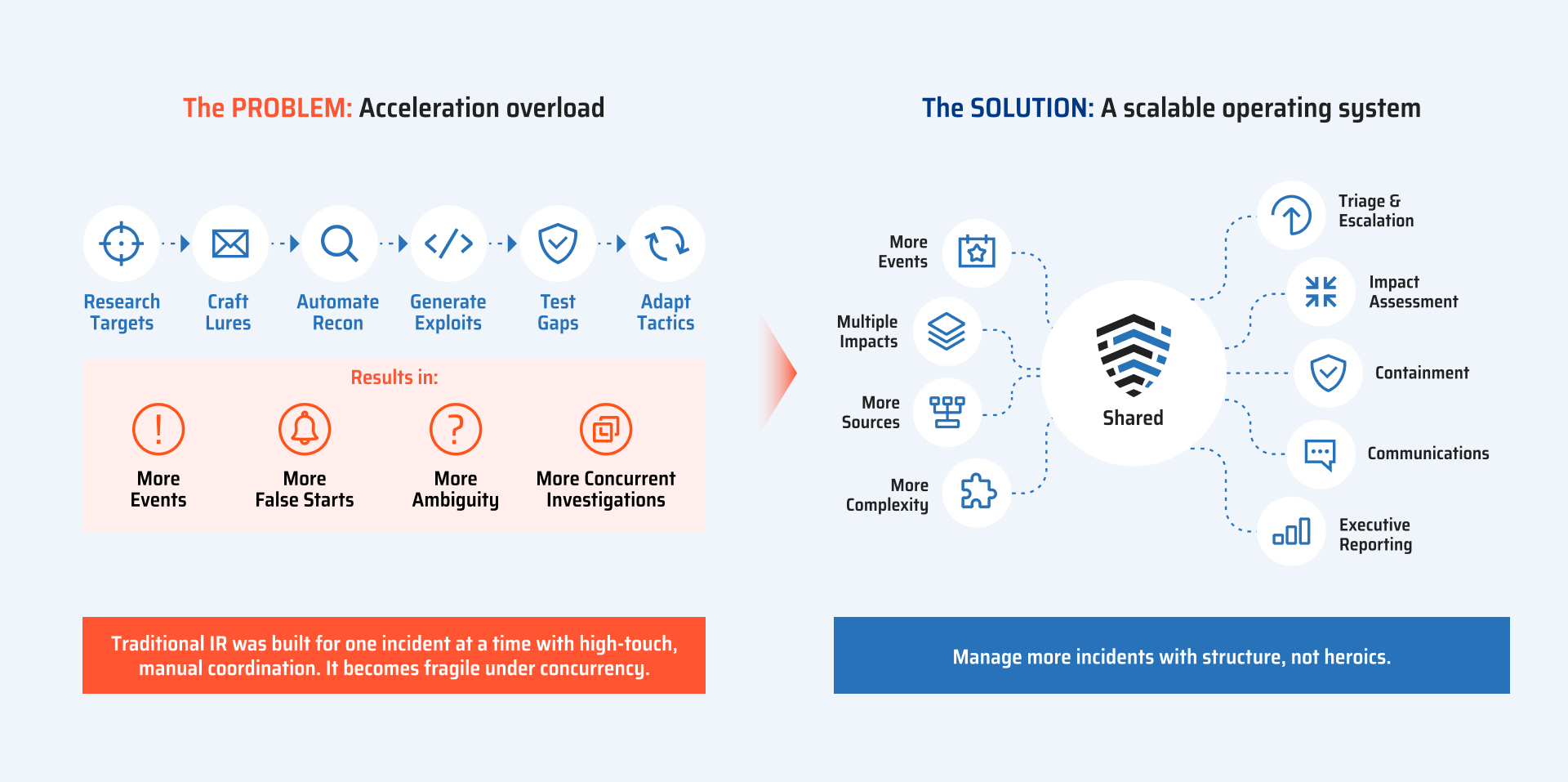
Enterprise incident response addresses this problem with a whole new approach. It treats incident management as a scalable operating system, not an improvised coordination exercise. The response structure, roles, workflows, procedures, timelines, and records are established inside a single system so the organization can manage more incidents without relying on heroics or memory.
AI exposes the scalability limits of traditional incident response
The third challenge is scalability. AI-accelerated incidents do not just move faster. They can also arrive in greater numbers, overlap, and stretch the response model itself.
Traditional incident response assumes the organization can focus attention around a manageable number of serious events. The right experts join the bridge call. Business teams are pulled in as needed. Updates are gathered manually, and decisions are tracked through meetings, messages, documents, or tickets. That approach can work when one major incident is unfolding and everyone is working from the same set of facts, but it breaks down when multiple matters move at once.
One team may be investigating a compromised SaaS account while another is assessing data exposure from a third-party integration. Legal may be evaluating one issue as communications drafts language for another. Meanwhile, new alerts keep arriving, each with its own urgency and uncertainty.
The problem is not commitment. It is capacity. Traditional response depends too heavily on human bandwidth. Experts become bottlenecks, updates get stale, and similar work is repeated. Leaders struggle to see which matters require immediate judgment and where resources should go next.
AI can make this harder by increasing the volume and ambiguity of what teams must handle. More signals need triage. More incidents may need escalation. More business functions may need to get involved earlier. A model built around manual coordination, static playbooks, and after-the-fact documentation cannot scale to that environment.
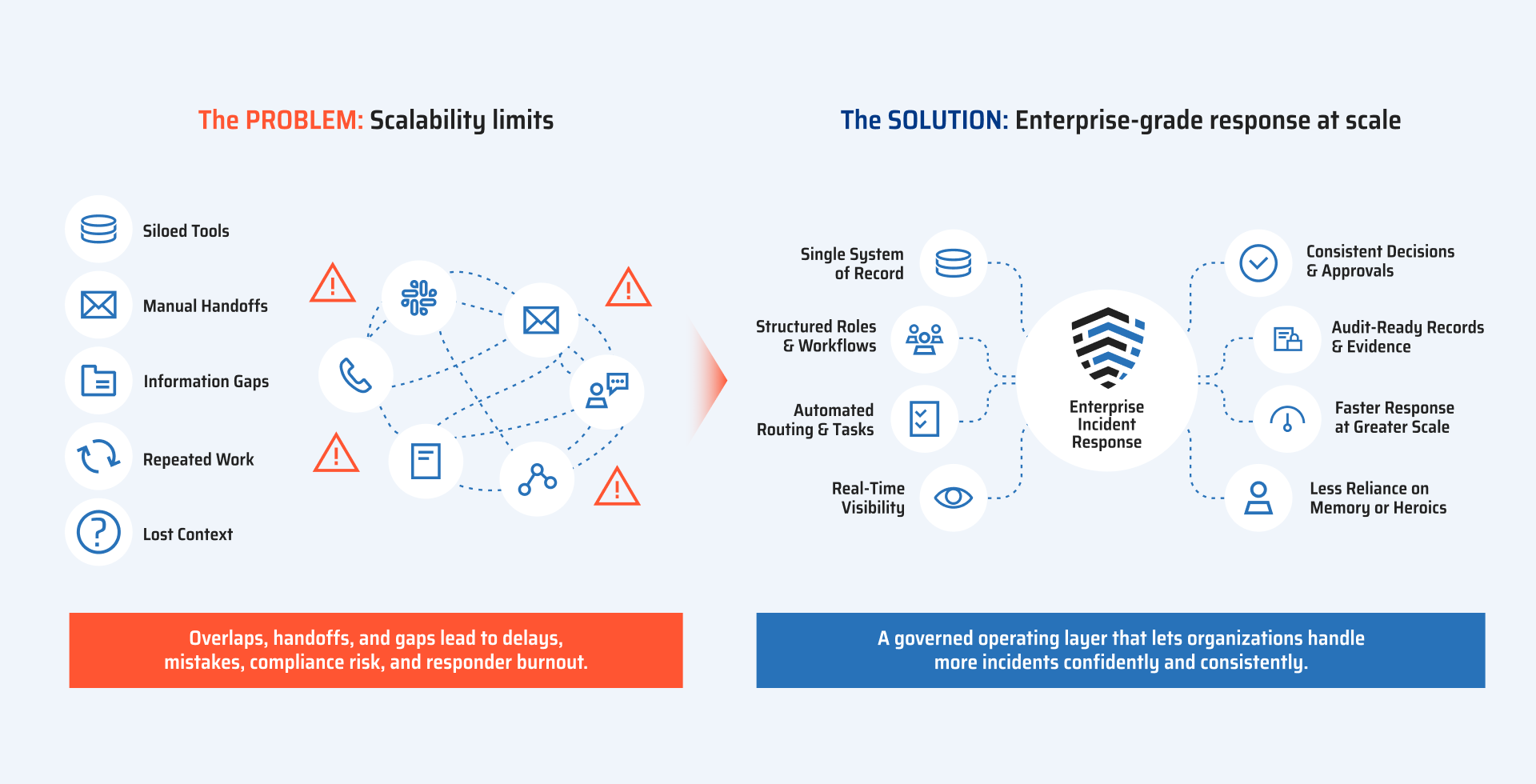
Enterprise incident response is designed for a different reality. It gives the organization a structured system for managing several incidents at once, not just one crisis at a time. Teams work from a shared operating layer where ownership, workflows, obligations, decisions, and records stay connected as the response evolves.
Rex helps make that operating model scalable. Rex AI agents gather context, surface dependencies, recommend next actions, track obligations, move workflows forward, and preserve the response record as work happens. Human leaders still make the consequential decisions. Rex helps ensure the enterprise can support those decisions at scale, with the right context and coordination in place.
What makes BreachRx different
The BreachRx Rex Platform™ is purpose-built for cyber incident response management, not generic task management and not another alert console. Our approach starts with a simple premise: once an incident crosses the organizational boundary, the enterprise needs a system of record for response itself.
That system must connect the technical investigation to the business response. It must know the roles involved, the decisions required, the right process to use, the obligations in play, the evidence collected, the approvals needed, and the timelines that matter. It must support legal, privacy, communications, security, IT, executives, outside counsel, insurers, and other stakeholders without forcing them to rely on disconnected tools.
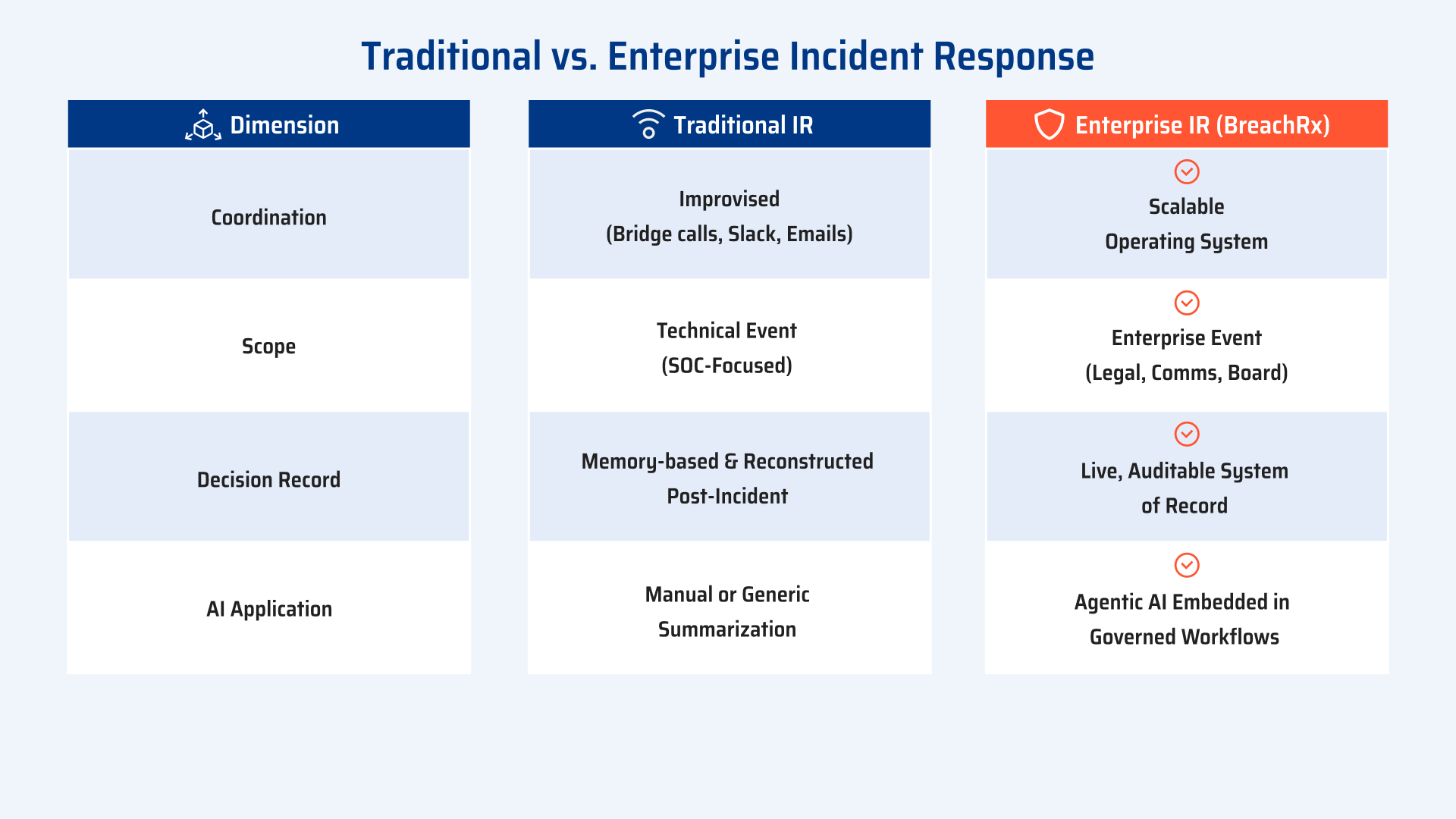
The BreachRx Rex Platform is our AI-powered enterprise response layer. It helps organizations turn incident intelligence into coordinated execution. Rex can guide teams through response workflows, coordinate cross-functional ownership, maintain a live incident record, identify potentially relevant obligations through Cyber RegScout®, support reporting readiness, and reduce the manual follow-up that slows teams down when pressure is highest.
This is where agentic AI matters. Generic AI can summarize notes or draft basic suggestions. BreachRx applies AI inside a governed response process. Agents operate in context, tied to the incident, the workflow, the organization’s obligations, and human approval points. That combination allows teams to scale response capacity without simply adding more meetings, more spreadsheets, or more headcount.
Chaos is optional
The next phase of cyber risk will not only be defined by more frequent and aggressive attacks. It will be defined by whether organizations can manage the enterprise consequences of those attacks at speed and scale.
Traditional incident response remains necessary as an aspect of a larger program, but it is no longer sufficient on its own. Detection, containment, and remediation answer only part of the challenge. AI-accelerated incidents require a broader response model: one that coordinates technical facts, business impact, legal obligations, executive judgment, communications, and evidence in real time.
That is enterprise incident response. And it is the standard that organizations need now.
Incidents are inevitable. Chaos is optional.