Top Enterprise Incident Response Platforms for 2026
Incident response is no longer confined to the security operations center. A significant incident can require simultaneous action from security, legal, privacy, communications, IT, risk, executive leadership, and outside advisers. Each team must operate from consistent facts while managing different responsibilities, deadlines, and confidentiality requirements.
Enterprise incident response management platforms address this coordination challenge. Unlike SIEM, EDR, and SOAR tools—which primarily support technical detection, investigation, and containment—these platforms help organizations manage the broader response: people, decisions, workflows, communications, regulatory obligations, and documentation.
The following platforms represent several of the leading approaches to enterprise incident response. They are not presented in ranked order; the right choice depends on an organization’s operating model, existing technology environment, and response priorities.
BreachRx Cyber Incident Response Management
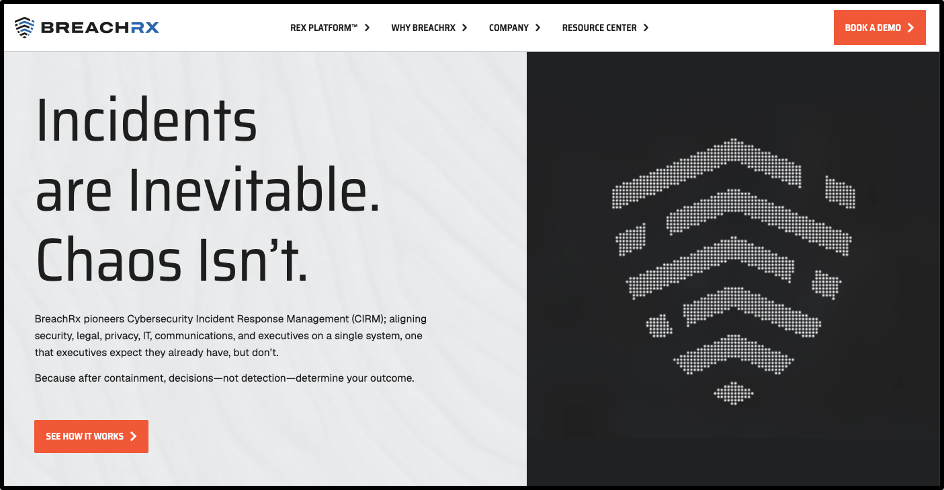
The BreachRx Cyber Incident Response Management (CIRM) is an agentic AI-powered incident command center for enterprise incident response. Its architecture combines specialized AI agents, a dynamic workflow engine, regulatory intelligence, and a centralized system of record to coordinate security, legal, privacy, communications, IT, and executive teams.
Embedded directly into response workflows, Rex AI continuously evaluates incident context, recommends next actions, adapts tasks and deadlines, processes documents, and produces stakeholder-specific reports. Cyber RegScout applies regulatory logic to evolving incident facts, helping teams identify potentially applicable obligations and manage overlapping reporting clocks.
The platform unifies incident management, continuous evidence capture, privileged communications, and defensible documentation within the same AI-enabled operating environment. Organizations can use this architecture for readiness exercises and live incidents, while Mobile Command enables executives to monitor developments and approve critical decisions remotely.
Rex complements SIEM, EDR, and SOAR tools by operating above the technical response layer. It serves as the intelligent coordination layer for the people, decisions, obligations, evidence, and workflows that determine the enterprise outcome.
Best For:
Organizations of any size seeking a mature, enterprise-grade incident response program. Rex helps large, regulated companies coordinate complex, cross-functional responses while enabling smaller organizations with lean teams to establish the structured workflows, regulatory processes, and defensible documentation capabilities typically associated with a fully staffed enterprise IR function.
AI Capability
Rex AI embeds an agentic AI workforce directly into incident workflows. Specialized agents can interpret changing context, recommend actions, advance playbooks, process documents, update tasks and deadlines, support regulatory analysis, and prepare reports for different stakeholders.
This model goes beyond general-purpose chatbots. Agents operate from live incident context and support distinct response functions while maintaining human review for consequential decisions. The goal is to help enterprises respond to faster, more complex, and potentially concurrent incidents without depending entirely on additional personnel.
Cydarm
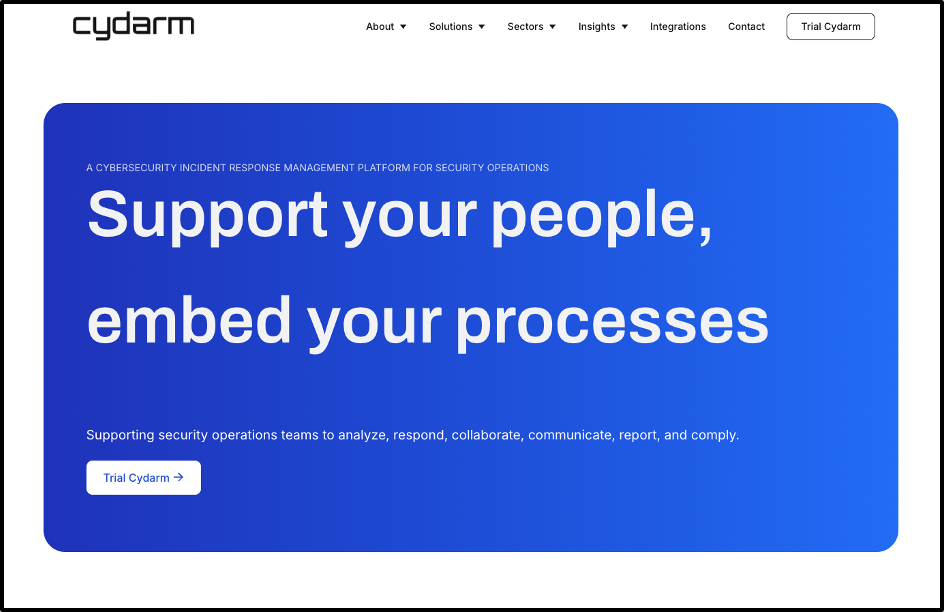
Cydarm is a cybersecurity incident response management platform with a strong foundation in security operations case management. It centralizes incident cases, investigation data, indicators, tasks, evidence, and communications while allowing teams to create configurable playbooks around their operating procedures.
Integrations and enrichment capabilities bring information from other security systems into each case, helping analysts reduce manual data collection and maintain a coherent incident record. Configurable workflows can be adapted to an organization’s processes, while ownership and service-level tracking help teams monitor performance.
Cydarm also supports collaboration with stakeholders outside the SOC. Attribute-based access controls can restrict sensitive cases or information to authorized participants. Timeline and audit capabilities preserve incident history, supporting post-incident reviews, compliance reporting, and regulatory scrutiny.
Compared with platforms that begin from an executive crisis-management perspective, Cydarm’s center of gravity remains closer to the operational security team. Its collaboration, reporting, and evidence capabilities can nevertheless extend the incident record to legal, compliance, and executive stakeholders.
Best For:
Security operations teams that need a purpose-built alternative to generic IT ticketing systems. It is a strong fit for organizations seeking configurable case management, analyst collaboration, security integrations and detailed operational workflows.
AI Capability
Cydarm takes a human-accountable approach to AI, emphasizing analyst augmentation and lower-risk automation rather than autonomous decision-making. Buyers should assess which activities AI can perform, such as enrichment, classification, summarization, documentation, and workflow recommendations. They should also determine whether AI primarily supports SOC cases or extends across legal, privacy, communications, and executive workstreams.
Organizations specifically seeking a multi-agent workforce for enterprise-wide response should carefully compare the breadth and maturity of Cydarm’s capabilities with platforms designed around that operating model.
CYGNVS
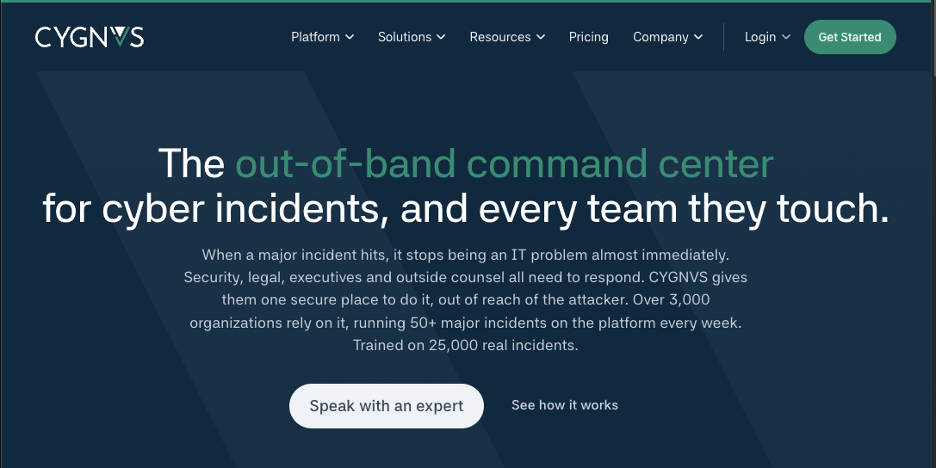
CYGNVS is a cyber incident response platform designed to remain available when an organization’s primary systems may be compromised. It provides virtual incident command rooms where internal teams, outside counsel, forensic providers, insurers, and other authorized participants can coordinate separately from potentially affected corporate infrastructure.
The platform supports preparation, tabletop exercises, active response, and post-incident reporting. Teams can establish response plans, assign responsibilities, share sensitive information, manage tasks, and communicate within controlled workspaces. Fine-grained access controls help organizations separate sensitive or privileged workstreams.
The platform also supports collaboration with external providers, making it useful for organizations whose response model depends heavily on insurers, breach counsel, forensic firms, and crisis communications agencies.
Best For:
Organizations that prioritize virtual incident rooms. It can be helpful for large-scale breaches, insurer-supported response programs, and enterprises that regularly coordinate with outside advisers.
AI Capability
CYGNVS offers an AI Incident Command Center. Its offering also helps organizations aggregate incidents involving their own AI systems, including data leakage, inaccurate outputs, bias, and uncontrolled agent behavior. Buyers should examine how deeply AI is embedded in live response workflows, what activities it can perform, and how recommendations are validated. CYGNVS’s AI capabilities are best considered alongside its principal strength: providing a secure, independently accessible environment for incident coordination.
Cytactic
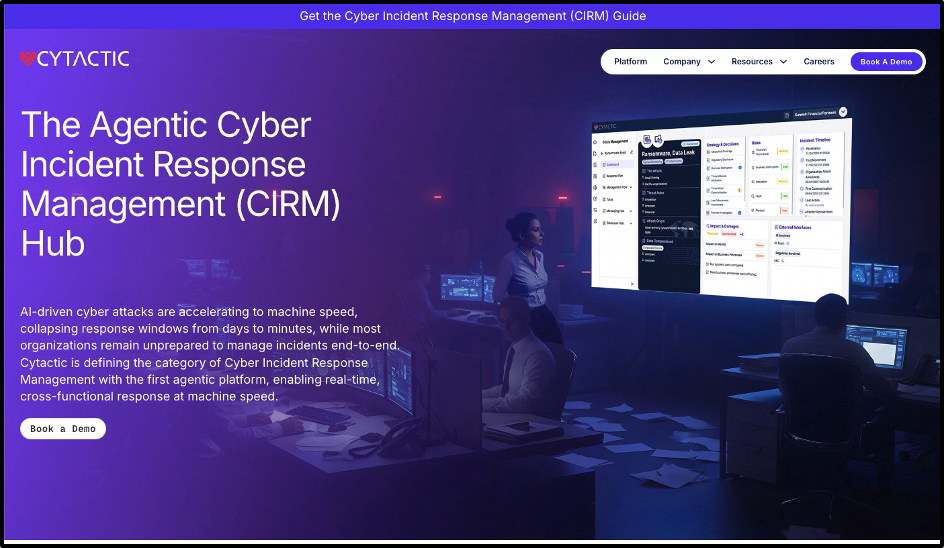
Cytactic provides a cyber incident response management platform focused on readiness, cross-functional coordination, and guided execution. It helps organizations move response plans out of static documents and into operational workflows that teams can practice and use during an incident.
The platform brings together response plans, stakeholder responsibilities, communications, tasks, and incident information. Its cross-functional model supports participation by security, legal, communications, management, and other business teams.
Readiness is central to Cytactic’s approach. Organizations can evaluate preparedness, develop plans, and conduct exercises before an incident occurs. In-platform simulation capabilities let teams rehearse scenarios using an environment connected to the one they will rely on during an actual event. Findings can then inform improvements to plans and workflows.
During an incident, Cytactic gives teams a central environment for coordinating actions and maintaining situational awareness, reducing dependence on spreadsheets, documents, and disconnected communications.
Best For:
Large, multijurisdictional organizations seeking to connect cyber readiness, tabletop exercises, and live incident coordination. It may appeal to companies building a cross-functional response program and wanting business leaders to work within the same framework as security teams.
AI Capability
Cytactic incorporates AI-assisted capabilities to help teams interpret incident developments, surface relevant information, and support workflow coordination. Its AI can provide guidance as conditions change, but appears primarily designed to assist users rather than operate as a specialized, multi-agent workforce across the response. Buyers should evaluate which capabilities are currently available, how deeply they extend into legal, regulatory, communications, and executive workflows, and the degree to which recommendations are explainable, validated, and subject to human approval.
IR-OS
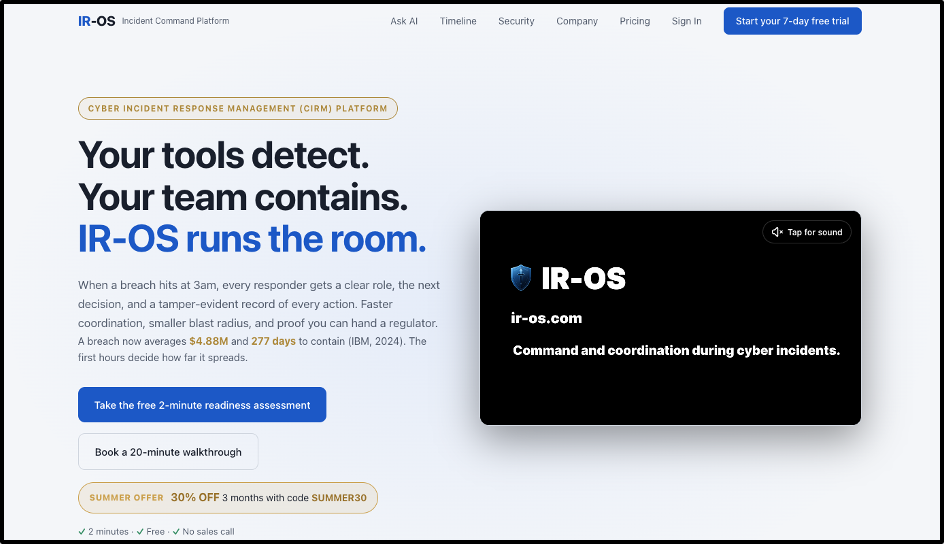
IR-OS is a cyber incident command platform focused on organizing the people, resources, and activities involved in incident response. It provides a central environment for declaring incidents, assigning roles, managing runbooks, tracking decisions, and maintaining communications and documentation from the initial alert through closure.
The platform offers task assignment, role-specific views, incident timelines, readiness tracking, and after-action reviews. Its incident-command structure helps teams maintain visibility into responsibilities, open actions, and response progress when technical and business participants are working simultaneously.
IR-OS also supports program preparation and improvement. Organizations can document response plans, prepare participants, conduct drills, identify readiness gaps, and track corrective actions following an incident or exercise.
Regulatory clocks and decision records help teams monitor deadlines and document how the response progressed. Overall, IR-OS is oriented toward creating structure, accountability, and situational awareness around human-led response activities. As a newer market entrant, buyers should validate its integration depth, deployment scale and customer references.
Best For:
Organizations looking for a centralized system to organize incident response teams, assign responsibilities, and track activities, deadlines, and resources. It may be particularly useful for teams that need greater structure and visibility without the complexity of a broad enterprise workflow platform.
AI Capability
IR-OS describes itself as an AI-native platform. Its capabilities include AI-assisted decision support, response-plan generation, role assignment, regulatory deadline tracking, and automated after-action reporting.
Buyers should examine how recommendations are grounded, whether the platform cites supporting information and how it prevents unverified content from entering executive or regulatory reports. A realistic exercise can help determine whether its AI remains effective when incident facts are incomplete, contradictory, or rapidly changing.
ServiceNow Security Incident Response
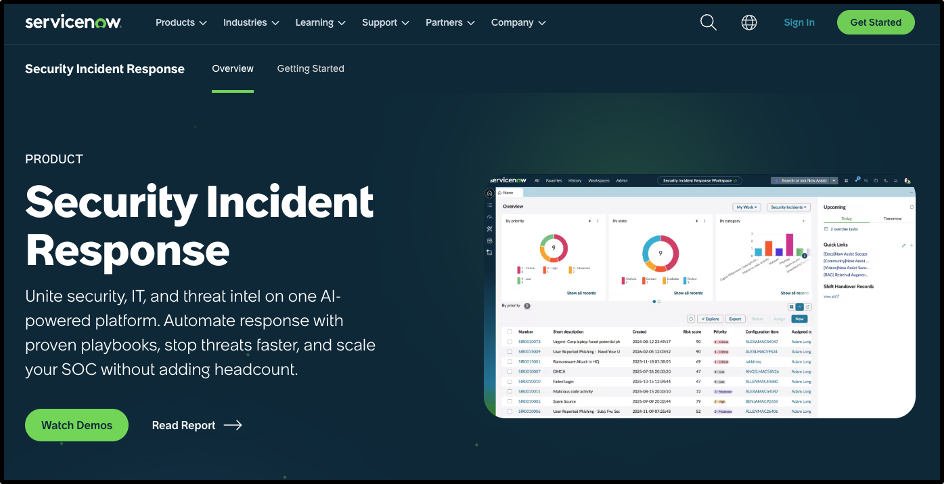
ServiceNow Security Incident Response is part of the broader ServiceNow Security Operations portfolio. It manages security incidents from initial analysis through containment, eradication, recovery, post-incident review, and closure.
Its primary advantage is integration with the ServiceNow ecosystem. Organizations already using ServiceNow for IT service management, configuration management, vulnerability response, and risk can connect security incidents with existing assets, owners, remediation processes, and operational data.
Security Analyst Workspaces, playbooks, and third-party integrations help analysts prioritize incidents and coordinate investigation and remediation. Workflows route tasks to security and IT teams, while analytics identify bottlenecks and measure response performance.
ServiceNow Security Incident Response is designed to operate within the broader ServiceNow platform rather than as a standalone enterprise incident response solution. Organizations typically need an established ServiceNow environment, supporting applications and additional configuration to address specialized requirements such as privileged legal workstreams, regulatory logic, crisis communications, and executive decision records.
Best For:
Large organizations already standardized on ServiceNow that want security incident management integrated with IT operations, asset data, and enterprise workflows. It is particularly valuable when technical remediation depends on established ServiceNow processes.
AI Capability
ServiceNow applies Now Assist and AI agents to security operations. Use cases include incident summarization, investigation assistance, shift handovers, incident wrap-up, and generation of knowledge-article drafts.
Its AI capabilities work best when it has access to the broader ServiceNow data and workflow ecosystem. Customers should nevertheless determine whether available agents address the complete enterprise response or primarily improve analyst productivity and technical remediation.
Choosing the Right Incident Response Platform
The best incident response platform depends on the problem an organization needs to solve. Some platforms excel at SOC case management, secure incident rooms, or integration with established IT workflows. Others concentrate on readiness, role assignment, and activity tracking. These capabilities can be valuable, but organizations should also consider whether a platform can coordinate the entire enterprise response, not only organize its individual parts.
As incidents accelerate and regulatory obligations multiply, the evaluation criteria are changing. Enterprises increasingly need a system that can interpret evolving context, adapt workflows, coordinate specialized teams, and continuously create a defensible record. AI should do more than summarize information or assist analysts. It should reduce the operational burden across security, legal, privacy, communications, and executive functions while preserving human control over consequential decisions.
This is where BreachRx offers a differentiated approach. The Rex Platform combines a centralized system of record, regulatory intelligence, privileged communications, and defensible documentation with an embedded agentic AI workforce. That architecture can help mature enterprises manage complex, concurrent responses while enabling leaner organizations to establish capabilities that would otherwise require a substantially larger incident response team.
Ultimately, buyers should evaluate platforms using realistic exercises, not feature checklists alone. The right solution should prove that it can keep teams aligned, advance work as facts change, and produce a clear record of what happened, what was decided, and why.
Talk to a BreachRx expert to learn how the Rex Platform can help your organization build a more coordinated, AI-powered, and defensible incident response program.