
The Impending Crisis of Incident Response
For the past decade, cybersecurity has focused heavily on improving technical detection, containment, and remediation. Organizations have invested billions of dollars into security tooling, security operations centers, threat intelligence, and increasingly automated response capabilities. While technical detection and response systems have matured significantly, the operational systems required to manage incidents once they occur have effectively stalled.
In many organizations, incident management remains an improvised coordination process layered on top of highly advanced security operations. That worked when incident volumes were manageable, they were relatively isolated, and reporting obligations were limited. But spreadsheets, conference bridges, and static playbooks no longer scale with the volume and velocity of incidents that modern enterprises now face with AI.
Offensive AI capabilities are lowering the barrier to sophisticated attacks while dramatically increasing speed, automation, and scale. At the same time, organizations are now expected to manage a much broader range of incidents than traditional cybersecurity events alone, including privacy, AI safety, compliance, and software vulnerability issues.
Regulatory pressure is also increasing. SEC cyber disclosure rules, CIRCIA, NYDFS requirements, and emerging international mandates are expanding both the number of incidents that require formal evaluation and the speed at which organizations are expected to respond. Disclosure thresholds are dropping, pushing more operational events into formal notification and reporting processes. For example, for certain serious cybersecurity incidents, China, Singapore, and India have reporting requirements of one hour, 2 hours, and 6 hours of awareness, respectively.
Taken together, these trends sharply increase the number of incidents organizations must coordinate, assess for disclosure, report across jurisdictions, and manage simultaneously under significant time pressure. What was once a manageable operational process is becoming a high-scale coordination problem.
Changes Driving Incident Volume and Complexity
 Offensive AI |  Response Complexity |  Increasing Regulations |
|---|---|---|
| Increases velocity and number of incidents | Concurrent incidents coordinated across multiple functions | Expanding regulations and lower disclosure thresholds |
The Breaking Point: Where the System Fails
Modern incidents are no longer handled by security teams alone. Significant incidents now require coordination across legal, compliance, privacy, communications, media relations, government affairs, executive leadership, and Boards of Directors. Each group introduces different responsibilities, escalation paths, and regulatory obligations. These response models do not scale effectively under concurrency and organizational complexity. As incidents begin occurring simultaneously across multiple domains and regulatory regimes, the coordination burden increases exponentially.
At a certain point, incident volume breaks through the operational capacity ceiling of manual and fragmented processes. Coordination degrades, decisions slow down, deadlines are missed, communications fragment, and risk compounds. The issue is not simply that organizations will face more incidents. It is that the operating models most organizations rely on today were never designed to function beyond the blue-shaded region shown below.
Incident Response Breaking Point
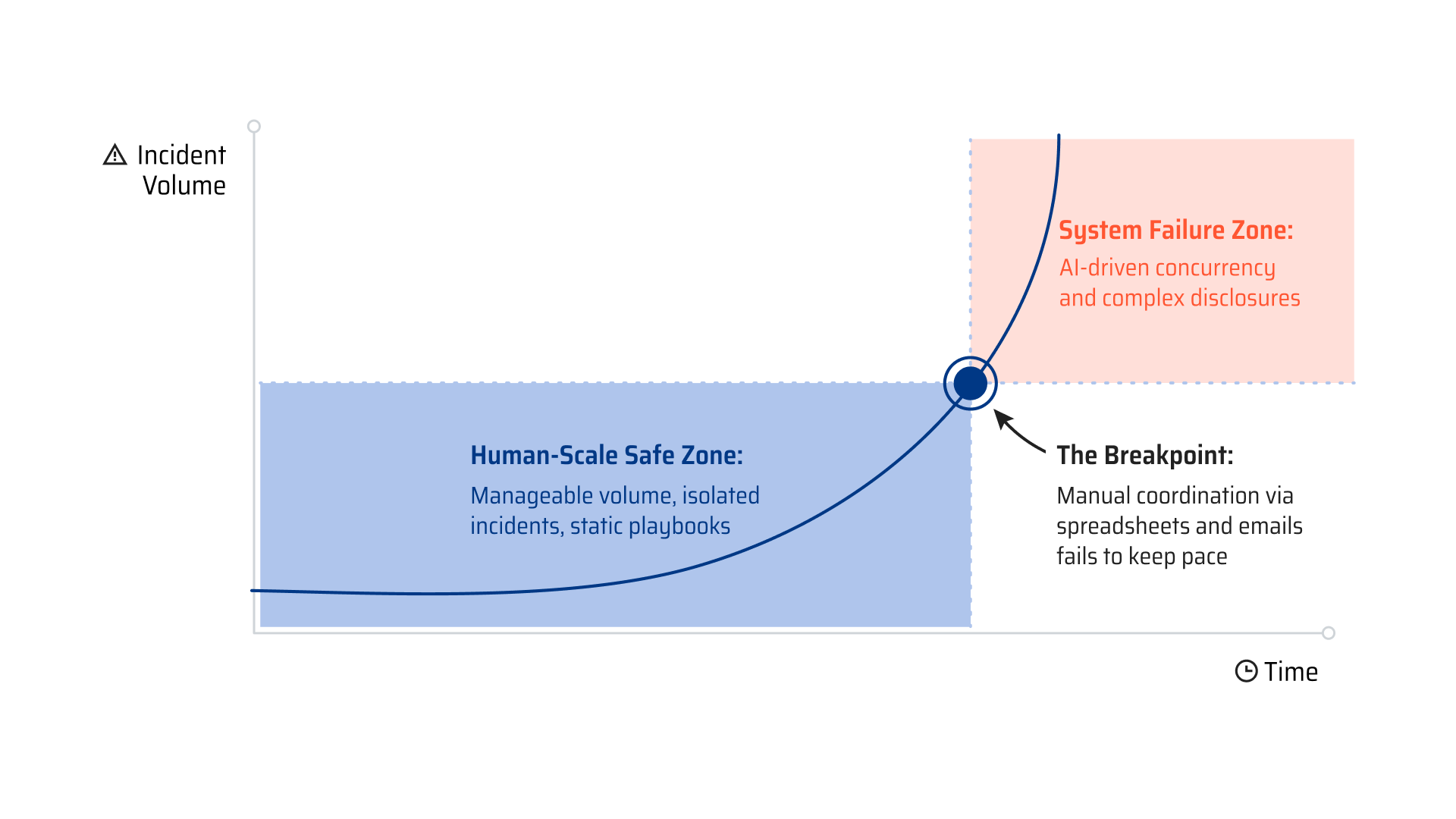
Structural Gap: Technical Detection & Response vs. Incident Management
The cybersecurity industry’s traditional focus has been to optimize technical detection and response capabilities. Security operations today are increasingly automated, data-driven, and designed to operate at machine speed. But incident management has evolved very differently.
Once an incident becomes an enterprise event, the challenge shifts from a technical response to incident management, aligning both the technical, business, and executive teams around decisions that often must be made under significant uncertainty and time pressure. This creates a structural gap between two very different operational systems.
Technical Detection & Response vs. Incident Management
| Technical Detection & Response | Incident Management | |
|---|---|---|
| Focus | Identifying, analyzing, and containing threats | Coordinating cross-functional decisions and disclosures |
| Pace | Machine-speed and automated | Human-speed and manual |
| Tooling | Highly engineered, heavily funded | Spreadsheets, static documents, emails, and messaging apps |
| Stakeholders | Security and IT | Legal, PR, Compliance, Exec Team, BOD |
What Has to Change
Organizations need operational systems purpose-built to manage high-concurrency, cross-functional, disclosure-driven incidents at scale. The industry is increasingly recognizing this shift. Gartner’s identification of the Cyber Incident Response Management (CIRM) capability signals that incident management itself is emerging as a distinct and critical area of investment.
Cyber Incident Response Management
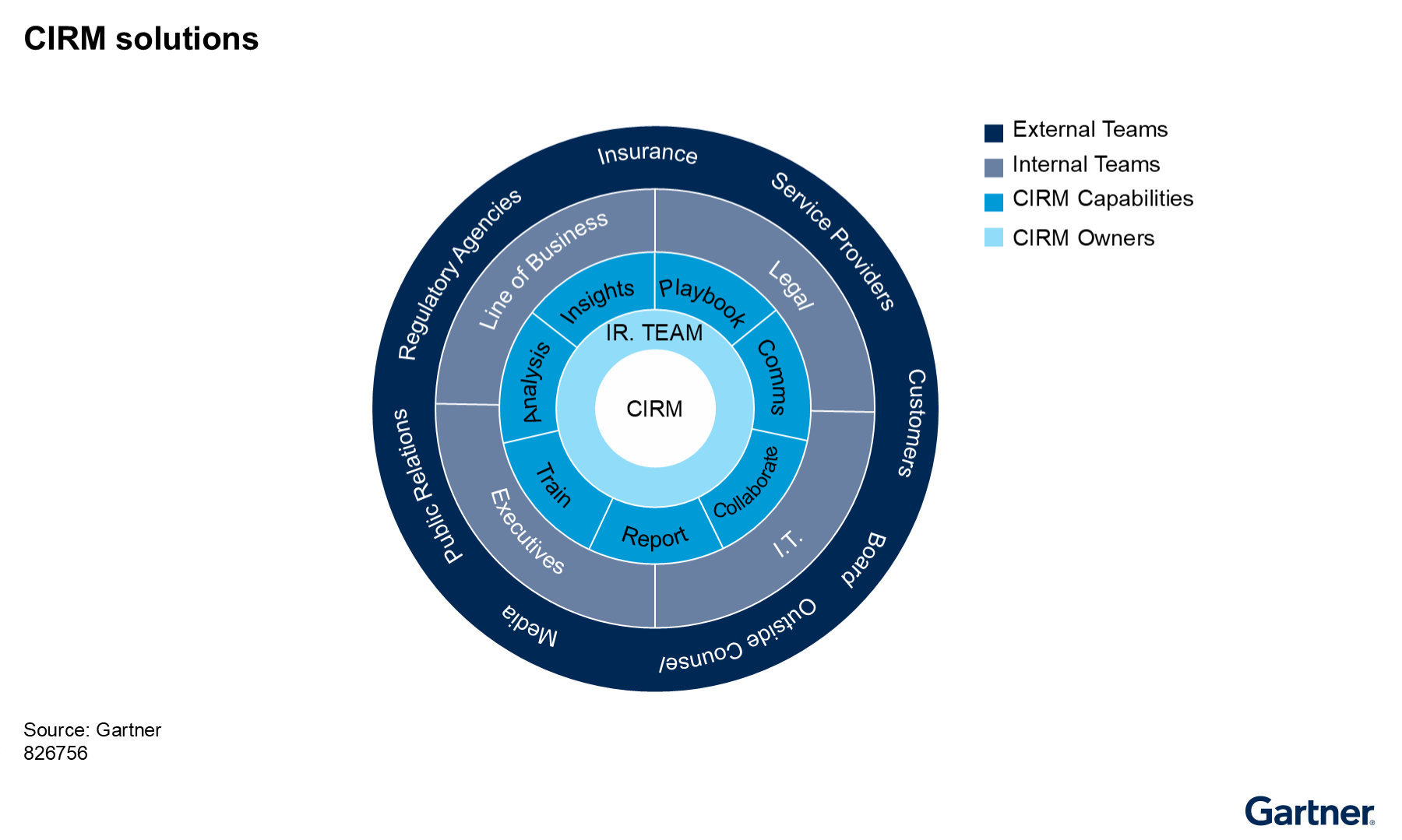
Gartner®, Innovation Insight: Cybersecurity Incident Response Management (CIRM), 13 January 2026.
GARTNER is a trademark of Gartner, Inc. and/or its affiliates.
Platforms offered by companies such as BreachRx are designed to manage them as complex enterprise events. They provide a shared operational layer across security, legal, communications, compliance, and executive teams, bringing together workflows, obligations, stakeholders, and timelines into a single coordinated system. This is what is required to evolve from ad hoc incident response toward scalable enterprise incident response infrastructure.
What Comes Next
Cybersecurity is entering a phase where the primary challenge is no longer detecting attacks. Organizations that succeed will be those that can operationalize decision-making, coordination, and disclosure management while enduring continuous and simultaneous incidents.
BreachRx’s purpose-built platform was designed specifically for this new environment. Their patent-pending Rex AI® is embedded directly into the operational layer, overcoming the limitations of human-scale incident management and enabling organizations to respond at machine speed. A central orchestration agent, Maestro, routes work between specialized agents for incident command, response execution, regulatory research, and readiness activities. The agents operate within the live response environment, maintaining context, interpreting incident facts, and adapting playbooks. This approach, unlike platforms with simple chatbots, reduces decision latency and helps organizations operate beyond the breaking point of manual coordination models.
Organizations that continue to rely on ad hoc coordination models will increasingly find themselves operating beyond their capacity limits. Those that invest in scalable enterprise incident management systems will define the next phase of our industry. The crisis is not coming from the attacks themselves. It is coming from our ability, or inability, to manage them.