

Out-of-Band Incident Response Shouldn't Wait for a Crisis

Surgeons don’t scrub in only for the hard cases. The operating room is sterile every time, because no one knows in advance which routine procedure will go wrong.
Incident response deserves the same discipline. Most security teams treat out-of-band communication as a break-glass measure, saved for ransomware or a compromised email system. Everything else runs in Slack, Teams and email threads until it gets serious.
That logic is backwards. Every major incident starts as a routine one: a phishing click, a vendor notice, a misconfigured bucket, an employee who downloaded the wrong file. By the time anyone calls it serious, the first decisions, the first record and the first exposure are already sitting in the wrong place.
You don’t know which incident is the big one until it’s too late to move it.
What is out-of-band communication?
Out-of-band communication means coordinating through channels that are independent of the systems under attack or investigation. If email, chat or identity is compromised, the people responding can still talk, decide and act.
It is not a niche idea. MITRE ATT&CK lists it as a formal mitigation, M1060, to “ensure the continuity of critical communications during security incidents.” CISA’s ransomware response guidance warns that “malicious actors may monitor your organization’s activity or communications” and tells responders to use out-of-band methods “to avoid tipping off actors.”
The warning is grounded in real behavior. MITRE documents that Scattered Spider searches victims’ Slack and Microsoft Teams “for conversations about the intrusion and incident response,” and their Exchange mailboxes for the same.
Attackers don’t just break in. They read the incident channel.
Moving the chat isn’t the same as moving the response
Most out-of-band plans stop at the conversation: a Signal group, a backup bridge line, personal phone numbers in a spreadsheet. That covers who can talk. It doesn’t cover what they’re talking about.
During an incident, responders need far more than a channel. They need the playbook, the contact list for counsel and forensics, the decision log, the evidence, the regulatory requirements and the notification drafts. In most organizations, all of that lives on SharePoint, Confluence, a ticketing system or a shared drive inside the environment being defended.
If your playbook lives on the network you’re defending, it isn’t out of band.
Out of band is a posture, not a product. It applies to five layers of the response:
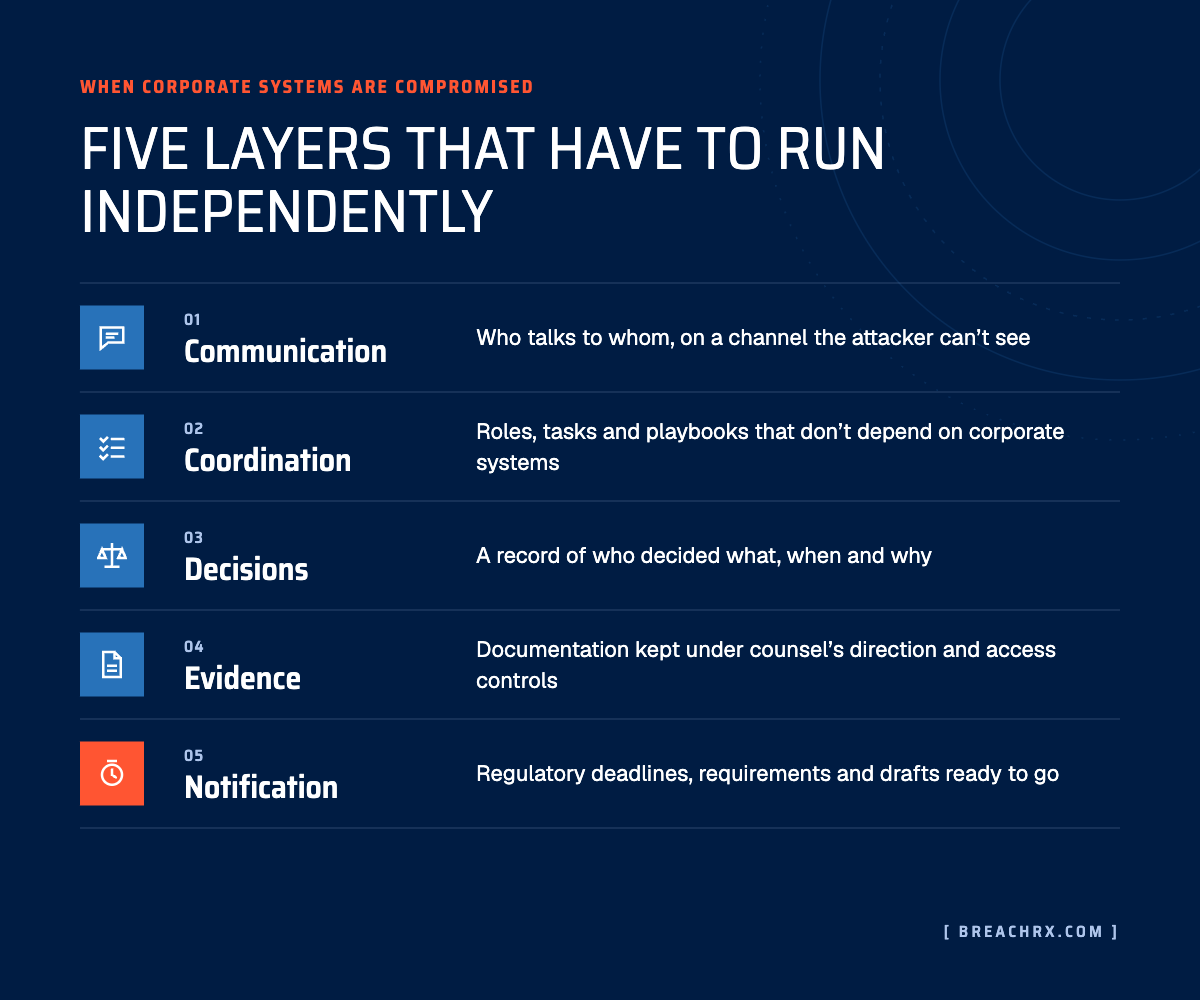
A secure chat channel covers the first layer. The other four are where incidents are won or lost.
Three everyday reasons to run every incident out of band
The case for out-of-band incident response doesn’t depend on a nation-state adversary. It rests on three things that are true of nearly every incident.
1. Everyone’s in the channel
Incidents routinely involve people who sit in your everyday tools. An employee under investigation. A contractor with workspace access. A vendor in a shared channel. Verizon’s 2026 Data Breach Investigations Report found third parties involved in 48% of breaches, and the human element in 62%.
Need-to-know isn’t a crisis-only control. It applies the moment an incident opens, and a general-purpose chat workspace was never built to enforce it.
2. Your incident chat is evidence
Slack threads and email chains are discoverable, scattered and inconsistent. In the Capital One breach litigation, a federal court ordered the company to hand over its forensic report. Among the factors: the report circulated widely inside the company, including to the incident response team.
Where the response happens, and who can see it, shapes what stays protected. Legal teams want a clean, controlled record on every incident, not just the ones that make headlines.
Run every incident like it might be the one regulators ask about.
3. The clock doesn’t check severity
Notification deadlines start from awareness or determination, not from when someone escalated. GDPR Article 33 expects notice “not later than 72 hours after having become aware” of a breach. The SEC requires public companies to disclose material incidents within four business days of a materiality determination, which must be made “without unreasonable delay after discovery.”
None of those rules care that the incident looked routine on day one. If the first 48 hours ran in email, the record regulators expect has to be reconstructed after the fact.
CIRM is out-of-band incident response
Cyber incident response management (CIRM) is what out-of-band looks like when it covers the whole response, not just the conversation. It gives security, legal, privacy, communications and executives one independent place to run an incident from first alert to final notification.
The reasons you want out-of-band communication are the same reasons you want CIRM:
- Independence: the response keeps running when corporate email, chat or identity can’t be trusted.
- Need-to-know: each person sees what their role requires, and nothing more.
- A defensible record: every task, decision and communication is captured in one place, as it happens.
- Deadline readiness: regulatory requirements and notification steps are built into the workflow, not looked up mid-incident.
The difference is when you use it. Out of band shouldn’t be a mode you switch into once things look bad. It should be where every incident starts.
CIRM makes out of band the default, not the exception.
BreachRx built its Rex Platform around that principle. Rex runs separately from the systems an attacker may have reached, and its Out-of-Band Comms solution gives teams backup email, chat, video and audio meetings, and shared workspaces that stay tied to the response record. Controlled workstreams keep sensitive legal discussions restricted but still connected to the wider response. Mobile Command gives leaders current status and decision context from their phones. Behind it, AI agents track regulatory obligations across jurisdictions, keep playbooks moving, capture evidence and draft executive reports. Participants, approved outside parties and permissions are set up before an incident, so teams never have to choose between a secure channel and a complete response.
The bottom line
Out-of-band communication protects the conversation. Out-of-band incident response protects the outcome.
Every incident starts small, and the ones that don’t stay small are the ones you’ll be asked to explain. If out of band is reserved for major incidents, you’ve already decided which incidents get a defensible record. You just don’t know which ones yet.
FAQ
What is out-of-band communication in incident response? It is coordination through channels independent of the systems under attack, so responders can communicate even if email, chat or identity is compromised.
What is out-of-band incident response? It extends out-of-band beyond communication to the whole response: playbooks, roles, decisions, evidence and regulatory notification all run independently of corporate systems.
Is CIRM the same as out-of-band communication? CIRM includes out-of-band communication, but goes further. It is the platform for running the entire incident response out of band, from first alert to final notification.
Should every incident run out of band, or only major ones? Every incident. Severity is rarely clear at the start, and notification clocks, need-to-know and legal privilege apply from the moment an incident opens.
Isn’t a backup Signal group or phone bridge enough? It covers who can talk. It doesn’t cover playbooks, evidence, decisions or deadlines, which usually still live inside the environment being defended.
Sources
- MITRE ATT&CK – M1060 Out-of-Band Communications Channel
- MITRE ATT&CK – Scattered Spider (G1015)
- CISA – I’ve Been Hit by Ransomware
- Help Net Security – Lessons from the Verizon 2026 DBIR
- Byte Back – Breach report in Capital One litigation not privileged
- GDPR Article 33
- Hunton – SEC finalizes cybersecurity disclosure requirements