


Incident Response Tabletop Exercises
What Is a tabletop exercise?
A tabletop exercise (TTX) is a facilitated, discussion-based session in which the people responsible for responding to a cybersecurity incident walk through a simulated scenario to test roles, decisions, escalation paths, and communications. A facilitator presents the scenario, introduces new developments called injects, and asks participants what they would do next. No production systems are touched.
NIST SP 800-84 defines a tabletop as a discussion-based exercise in which personnel with roles in a plan meet to validate that plan by discussing how they would respond to a particular emergency.
In cybersecurity, tabletop exercises are most often used to test an incident response plan: whether the right people are involved, whether they know who owns each decision, and whether the plan holds up when facts are incomplete and deadlines are running.
Why are tabletop exercises important?
Tabletop exercises expose coordination gaps before a real incident does. A significant cyber incident quickly pulls in security, IT, legal, privacy, communications, compliance, and executive leadership. Each team makes time-sensitive decisions based on facts that are still changing.
A well-run tabletop helps organizations:
- Clarify ownership of decisions such as system shutdowns, materiality assessments, regulatory notifications, and public statements
- Validate escalation paths so the right leaders are engaged at the right severity level
- Test communications, including out-of-band channels when email or collaboration tools may be compromised
- Rehearse regulatory decisions under overlapping reporting clocks and regulatory concurrency
- Identify missing information, contacts, playbooks, or vendor dependencies
- Demonstrate readiness to boards, auditors, regulators, and cyber insurers
Because tabletops test people and processes rather than technology, they reveal problems that penetration tests and red team engagements cannot: unclear authority, slow handoffs, and conflicting assumptions between teams. But that should be the starting point, not the finish line. BreachRx views readiness as the ability to establish command, coordinate across functions, make defensible decisions, and keep execution moving as facts, business impact, and obligations change.
What should a modern cybersecurity tabletop prove?
A modern tabletop should prove that the enterprise can operate under uncertainty, not simply that participants know what the incident response plan says. BreachRx views operational readiness as the ability to establish command, coordinate across functions, make defensible decisions, and adapt execution as the incident changes.
That changes the standard for a successful exercise. Instead of asking only whether everyone knew the plan, teams should test whether they can:
- Establish a clear incident commander and decision owners quickly
- Keep security, legal, privacy, IT, communications, executives, and outside partners working from the same evolving facts
- Make and document high-stakes decisions before the facts are complete
- Manage concurrent technical, business, customer, and regulatory workstreams without losing ownership or deadlines
- Turn observed gaps into workflow, playbook, role, and escalation changes that are retested
- This is the same shift behind Cybersecurity Incident Response Management (CIRM): from fragmented, meeting-driven response to a governed, repeatable enterprise operating process. The goal of a tabletop is not to get better at tabletop exercises. It is to get better at incidents.
What is the difference between a tabletop, functional, and full-scale exercise?
A tabletop is discussion-based; functional and full-scale exercises require participants to carry out response actions. NIST SP 800-84 distinguishes tabletop exercises from functional exercises, which validate operational readiness in a simulated operational environment.
| Exercise type | Format | Systems involved | Best for |
| Tabletop exercise | Facilitated discussion of a scenario | None | Testing roles, decisions, escalation, and communications |
| Micro tabletop | Short, focused session on one decision, handoff, or threat | None | Frequent practice between larger exercises |
| Functional exercise | Participants perform assigned tasks in a simulated environment | Simulated or controlled | Validating procedures, tasking, and timing |
| Full-scale exercise | Coordinated, real-time response across teams and partners | Live or near-live resources | Testing the full response capability end to end |
| Red team engagement | Scoped adversary simulation | Production or staging | Testing detection and technical defenses |
Most organizations start with tabletops because they are low cost and low risk, then add functional exercises as their program matures.
How do you run a tabletop exercise?
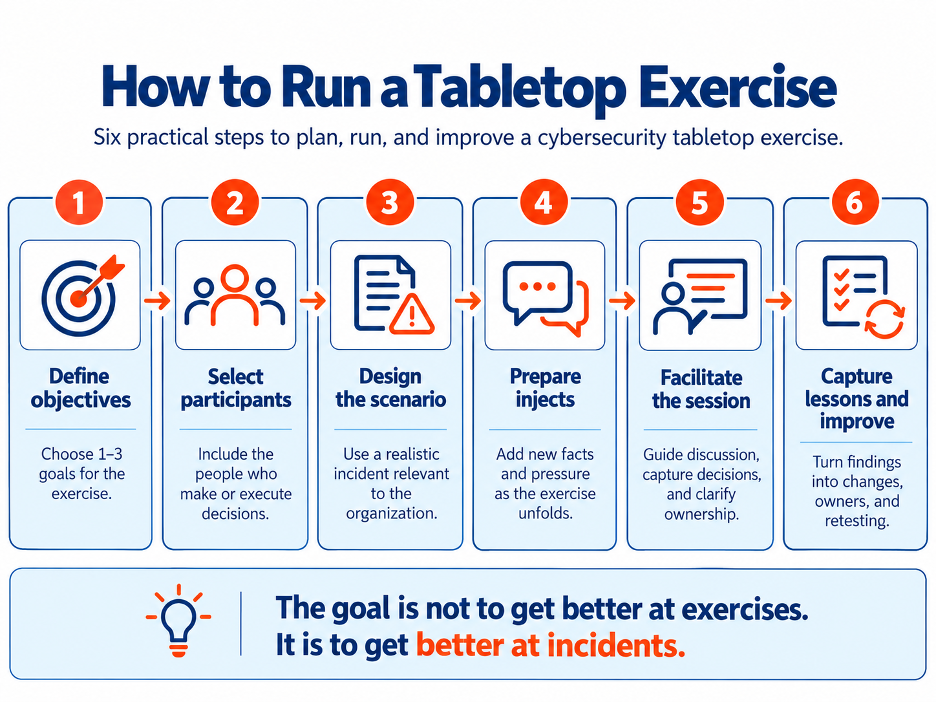
An effective tabletop exercise follows six steps: define objectives, select participants, design the scenario, prepare injects, facilitate the session, and turn findings into changes.
- Define objectives
Choose one to three measurable goals, such as validating the ransomware playbook, testing the materiality decision process, or confirming how legal and communications approve external statements. Objectives determine scope and participants. - Select participants and roles
Invite the people who would make or execute decisions in the scenario. Assign a facilitator, a note-taker or evaluator, and, where useful, observers. - Design a realistic scenario
Base the scenario on threats relevant to your organization, industry, and recent incidents. Start with a plausible first signal, such as an unusual alert, a vendor notice, or an extortion email. - Prepare injects
Plan timed developments that add pressure and new facts: evidence of data exfiltration, a journalist inquiry, a regulator’s question, a failed backup, or a second concurrent incident. - Facilitate the session
Present the scenario in stages. Ask who owns each decision, what information they need, and what they would do next. Capture decisions, assumptions, and disagreements as they happen. - Capture lessons and improve
Produce an after-action report that lists gaps, owners, and deadlines. Update plans, playbooks, contact lists, and workflows, then retest the weak points in a later exercise.
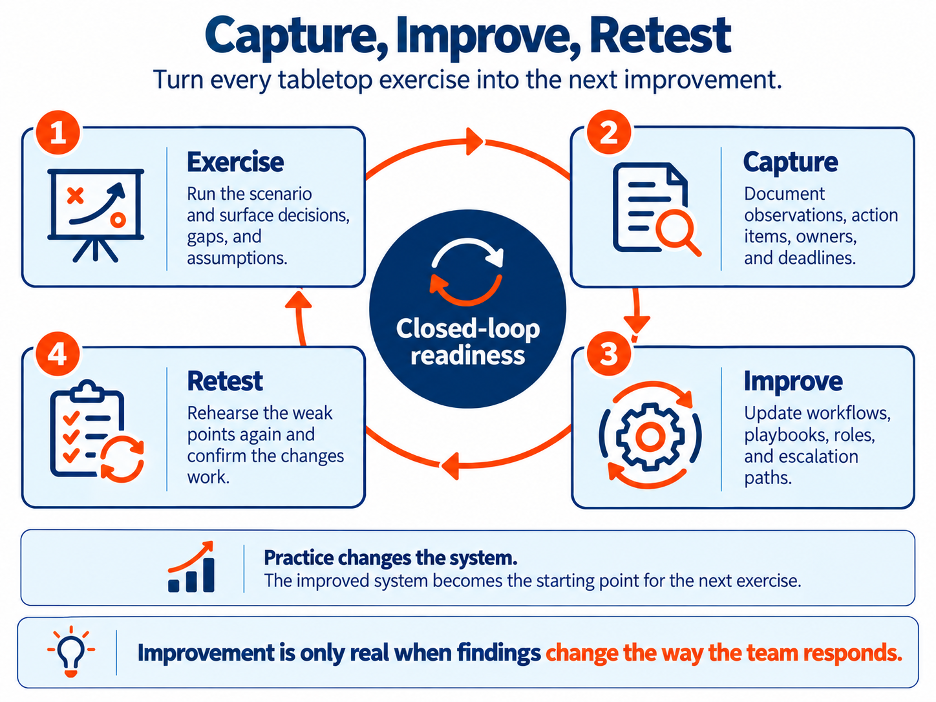
The improvement step is where many programs fall short. An after-action report is not the outcome; operational change is. Findings should become revised workflows, ownership, escalation paths, communications plans, and procedures, then be retested. Findings that stay in meeting notes rarely change how teams respond during a real incident.
Who should participate in a tabletop exercise?
Include every function expected to make or execute decisions in the scenario. A security-only exercise cannot reveal the handoff, authority, and communication gaps that appear between teams.
- Security and incident response to lead investigation, scoping, and containment decisions
- IT and infrastructure to assess system impact, restoration, and backup recovery
- Legal and outside counsel to evaluate obligations, privilege, and liability
- Privacy and compliance to determine notification and reporting requirements
- Communications to prepare employee, customer, media, and investor messaging
- Executives and business leaders to decide on operations, disclosure, and resources
- External partners such as forensic firms, breach counsel, insurers, and critical vendors
- Facilitator and evaluators to run the scenario and record decisions and gaps
Not every exercise needs every team. Targeted sessions with one or two functions let organizations rehearse specific handoffs more often.
What are common tabletop exercise scenarios?
The best scenarios reflect the threats your organization is most likely to face and the decisions it finds hardest to make.
| Scenario | Key decisions it tests |
| Ransomware and extortion | System shutdown, backup recovery, ransom payment policy, law enforcement engagement |
| Data breach with exfiltration | Scoping affected data, privacy notification, customer communications |
| Third-party or supply chain compromise | Vendor coordination, contractual obligations, downstream customer impact |
| Compromised identity or credentials | Access revocation, privileged account response, out-of-band communications |
| Cloud or SaaS incident | Shared responsibility, provider escalation, evidence preservation |
| Insider threat | HR and legal coordination, evidence handling, confidentiality |
| Autonomous AI agent incident | Attribution, containment of AI systems, novel regulatory questions |
| Concurrent incidents | Staffing strain, prioritization, multiple regulatory clocks |
Scenarios built on recent public incidents are especially useful because boards and executives often ask whether a similar event could affect their organization. See how BreachRx turned the July 2026 Hugging Face incident into an AI tabletop exercise.
What frameworks and resources guide tabletop exercises?
Two U.S. government resources are the most widely referenced starting points for cybersecurity tabletop exercises.
NIST SP 800-84
NIST Special Publication 800-84, Guide to Test, Training, and Exercise Programs for IT Plans and Capabilities, explains how to establish a test, training, and exercise (TT&E) program. It details two exercise types, tabletop and functional, and recommends objective-first planning, defined participant roles, and after-action reporting.
CISA Tabletop Exercise Packages (CTEPs)
CISA Tabletop Exercise Packages are free, customizable kits that include template objectives, scenarios, and discussion questions. CISA offers more than 100 packages, with cybersecurity scenarios covering ransomware, insider threats, phishing, and industrial control system compromise, plus sector-specific options.
How these fit with incident response frameworks
Tabletop exercises support the Prepare and Learn phases of incident response frameworks such as NIST SP 800-61 Revision 3 and the SANS PICERL model. They test whether the plan works, then feed lessons learned back into it.
Are tabletop exercises required by regulation?
Several regulations and standards require organizations to test their incident response plans at least annually. Few name tabletop exercises explicitly, but tabletops are a common way to meet these testing obligations.
| Regulation or standard | Testing requirement |
| NYDFS 23 NYCRR 500.16(d) | Covered entities must test incident response and BCDR plans periodically, and at least annually, with all staff and management critical to the response, and revise plans as needed. |
| PCI DSS v4.0 Requirement 12.10.2 | The security incident response plan must be reviewed, updated as needed, and tested at least once every 12 months. PCI guidance cites tabletop exercises as a way to test. |
| EU DORA Article 11(6) | Financial entities must test ICT business continuity and response and recovery plans at least yearly and after substantive changes. Most must include cyberattack scenarios. |
An annual test satisfies the minimum, but threats, teams, vendors, and regulations change far more often. Many organizations run broader exercises annually and targeted sessions quarterly, monthly, or after major changes.
Testing requirements depend on the organization, jurisdiction, industry, and applicable law. The examples above are illustrative and are not legal advice.
Why do annual tabletop exercises fall short?
An annual tabletop can satisfy a calendar requirement without proving operational readiness. BreachRx views compliance evidence and readiness as different outcomes: a once-a-year, discussion-only exercise may validate a plan, yet still leave untested the coordination, decision-making, and execution the enterprise needs under pressure.
Common shortcomings include:
- Scripted scenarios that do not change as participants respond
- Theoretical discussion disconnected from the workflows teams use in real incidents
- Infrequent practice, so new team members and changed procedures go untested
- Findings that never become changes to ownership, escalation, or procedures
The gap matters more as incidents become faster and more concurrent. BreachRx research across five major cyberattacks found that a single organization can face more than 100 reporting obligations while the facts are still evolving. A tabletop that rehearses only technical containment misses the system-scale coordination problem modern incidents create.
How do micro tabletops support continuous readiness?
Micro tabletops are short, focused exercises, often 30 to 45 minutes, that test one team, handoff, decision, or emerging threat at a time. BreachRx views them as the connective tissue between annual exercises and live response: focused rehearsals that make continuous readiness practical and let teams retest weak points as people, technology, vendors, regulations, and threats change.
Organizations use micro tabletops to validate an updated runbook, onboard a new incident commander, rehearse a regulatory notification decision, test a third-party handoff, practice out-of-band communications, or retest a weakness found in an earlier exercise.
How should organizations measure tabletop readiness?
Completing the exercise is not the best measure of a tabletop program. BreachRx recommends looking for evidence that response capability is becoming faster, clearer, and more repeatable.
Decision latency. How quickly did the right owner get enough information to make a decision?
Ownership clarity. Were actions, approvals, and escalations assigned without ambiguity?
Cross-functional handoffs. Did work move cleanly between security, legal, privacy, IT, communications, and leadership?
Fact consistency. Did teams maintain a common, current view as the scenario changed?
Improvement closure. Were gaps converted into owned corrective actions and then retested?
Over time, the objective is a closed-loop readiness program: exercise, capture, improve, retest. The strongest signal is not a clean tabletop; it is whether the organization improves the operating system it will depend on during the next incident. For additional guidance, see 7 Ways to Improve Your Cybersecurity Tabletop Exercises.
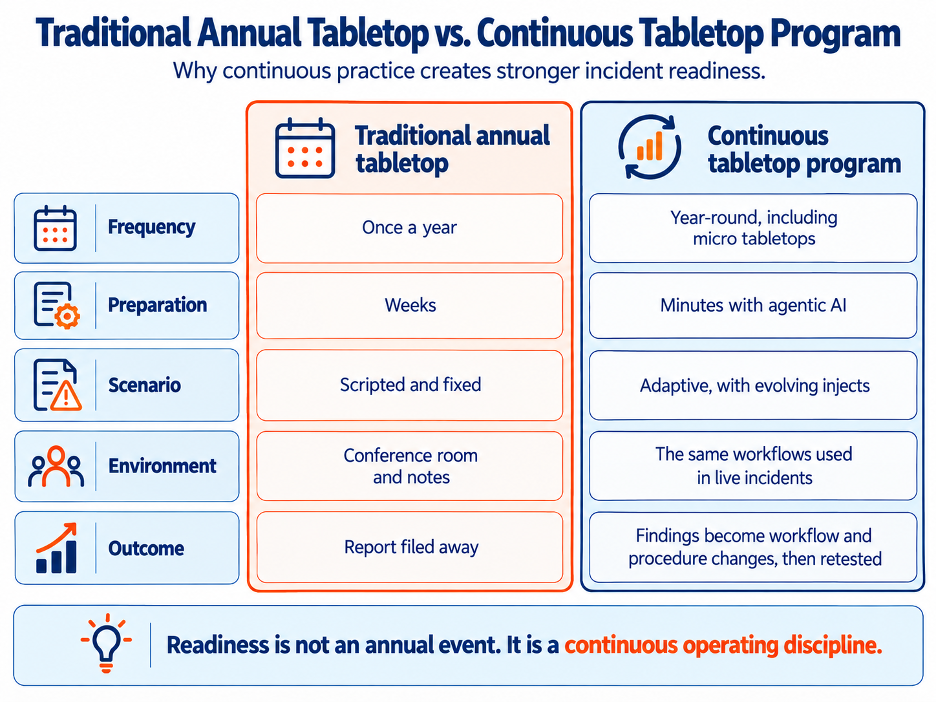
| Traditional annual tabletop | Continuous tabletop program | |
| Frequency | Once a year | Year-round, including micro tabletops |
| Preparation | Weeks | Minutes with agentic AI |
| Scenario | Scripted and fixed | Adaptive, with evolving injects |
| Environment | Conference room and notes | The same workflows used in live incidents |
| Outcome | Report filed away | Findings become workflow and procedure changes, then retested |
How does BreachRx help with tabletop exercises?
BreachRx is built around a simple premise: teams should practice incident response the way they expect to execute it. BreachRx AI Tabletop Exercises run inside the Rex Platform™, the same Cybersecurity Incident Response Management (CIRM) environment teams use during live incidents. That connects preparation, practice, execution, and improvement in one operating model instead of treating the tabletop as a separate annual event.
Rehearse in real workflows. Security, legal, privacy, IT, communications, and leadership receive assignments, track tasks, and document decisions exactly as they would in a live event. Facilitators introduce new developments and observe how teams coordinate. When the scenario requires it, teams can also rehearse out-of-band communications instead of merely talking about what they would do if primary systems could not be trusted.
Adaptive injects and evolving scenarios. Exercises introduce new facts, shifting business impact, regulatory triggers, and concurrent incidents, so teams practice reprioritizing when the scenario does not follow a script. The objective is to rehearse decision-making under uncertainty, not memorization of a scenario.
AI Tabletops on Demand. Powered by Rex AI®, AI Tabletops on Demand reduces the work of preparing, running, and documenting exercises from weeks to minutes. The Rex AI Exercise Agent, coordinated through Maestro, generates facilitator content, injects, timelines, discussion prompts, participant materials, and follow-up reporting. Teams can run annual, monthly, or even biweekly micro tabletops. BreachRx-moderated tabletops are also available for teams that want expert facilitation.
Regulatory context built in. Using Cyber RegScout®, exercises highlight potential regulatory triggers and update tasks, deadlines, and escalation and disclosure milestones as the scenario changes. This lets teams rehearse regulatory concurrency as an operational workstream rather than a separate legal research exercise.
A defensible exercise record. Decisions, observations, gaps, and follow-up actions are captured as the session runs. AI actions are timestamped and attributable, and access-controlled workspaces can separate privileged legal discussions. Teams produce after-action reports, executive summaries, and gap analyses without rebuilding the exercise from notes.
Findings become improvements. Insights translate directly into updated workflows, ownership structures, and response procedures in the Rex Platform, so the next exercise, or real incident, starts from an improved baseline. This closes the loop between readiness and response: practice changes the system, and the improved system becomes the starting point for the next practice or real event.
To see what a facilitator-ready scenario looks like, download the Autonomous AI Agent Data Breach Tabletop Exercise Guidebook, a 60- to 75-minute exercise with four escalating injects modeled on public reporting of the July 2026 Hugging Face incident. Or request a demo of BreachRx AI Tabletop Exercises.
Frequently Asked Questions
1. What is the goal of a tabletop exercise?
The goal of a tabletop exercise is to test roles, decisions, escalation paths, and coordination in a facilitated discussion so that weaknesses are found and fixed before a real incident exposes them.
2. How long does a tabletop exercise take?
Traditional enterprise tabletop exercises often run a half day to a full day. Micro tabletops focused on a single decision or handoff can run 30 to 45 minutes.
3. How often should organizations run tabletop exercises?
Regulations such as NYDFS Part 500, PCI DSS, and DORA require incident response or recovery plan testing at least annually. Mature programs exercise more often, combining annual cross-functional exercises with shorter sessions after changes in personnel, technology, vendors, regulations, or threats.
4. What is an inject in a tabletop exercise?
An inject is a new piece of information the facilitator introduces during the exercise, such as evidence of data theft, a media inquiry, or a ransom demand. Injects force participants to reassess priorities and make decisions as conditions change.
5. Who facilitates a tabletop exercise?
A tabletop is usually facilitated by an internal incident response lead, a risk or resilience manager, or an external specialist. The facilitator presents the scenario, delivers injects, guides discussion, and ensures decisions and gaps are recorded.
6. What should a tabletop exercise after-action report include?
An after-action report should summarize the scenario and objectives, list decisions made, identify gaps and their root causes, and assign owners and deadlines for each improvement. It should also note which items to retest in a future exercise.
7. What is the difference between a tabletop exercise and a penetration test?
A tabletop exercise tests people and processes through discussion, without touching systems. A penetration test or red team engagement tests technical defenses by attempting to exploit systems. Organizations need both.
8. What are micro tabletop exercises?
Micro tabletop exercises are short, focused sessions that rehearse one team, handoff, decision, or emerging threat at a time. They let organizations practice more frequently between larger enterprise exercises.
9. When is a tabletop exercise not enough?
A discussion-only tabletop is not enough when teams need to rehearse execution: assigning tasks, tracking deadlines, coordinating handoffs, and documenting decisions under changing conditions. Running exercises inside the same workflows used for live incidents closes that gap.
10. How does AI help with tabletop exercises?
Agentic AI can generate scenarios, injects, timelines, facilitator guides, and after-action reports, cutting preparation from weeks to minutes. This makes frequent, threat-specific exercises practical. BreachRx AI Tabletops on Demand uses Rex AI to build exercises from a single prompt inside the Rex Platform.
Martin Johnson, Head of Product Marketing, BreachRx · Last updated: Sept 25, 2026